RCM Services Under GST in India (2026) – Complete List
Published on: Sat Jan 17 2026Satendra Mishra

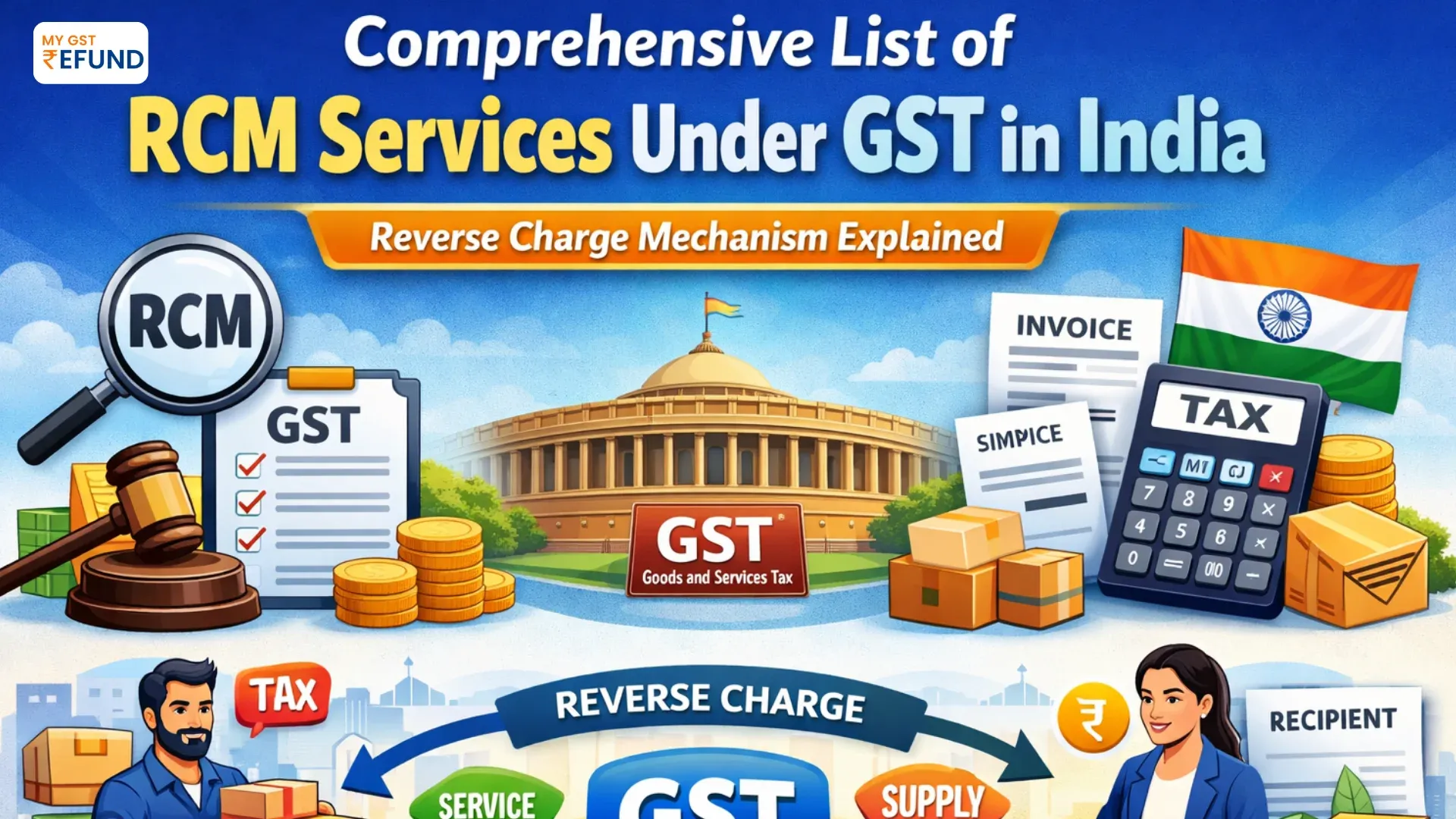
Comprehensive List of RCM Services Under GST in India
The Reverse Charge Mechanism (RCM) under the Goods and Services Tax (GST) regime in India is a mechanism that shifts the liability of paying tax from the supplier to the recipient of goods or services in specified cases. This is intended to broaden the tax base, draw unorganised suppliers into the tax bracket, and enforce tax where it is difficult to directly collect from some suppliers.
According to the latest updates mandated for 2026, it is essential to understand which services should be categorised as RCM, so that the business does not risk non-compliance, interest, and penalties, as well as report taxes accurately in returns.
What is the Reverse Charge Mechanism (RCM) in GST?
Under the forward charge mechanism, the supplier collects GST from the recipient through the invoice and remits it to the government. However, the burden to pay GST is passed to the service receiver.
This usually happens when:
- The supplier is not registered, or
- Under the law of GST, the service is notified as reverse charged.
RCM due to receipt of services from an unregistered supplier under Section 9(4) applies only to notified classes of registered persons and is not generally applicable to all businesses.
Who Must Pay GST Under RCM?
Under the GST regime, a registered person is liable to pay tax liability either of the two modes, e.g., forward charge, reverse charges in terms of section 9(3) and 9(4) of the CGST Act, 2017. This applies to:
Registered businesses that are receiving specified services.
Foreign service importers.
Buyers of services from unregistered suppliers only where Section 9(4) has been specifically notified for such a class of registered persons
Tax paid under RCM should be reported under Table 3.1(d) of Form GSTR-3B, and input tax credit (ITC) is allowable under the same period with the normal conditions.
Comprehensive List of RCM Services in India (2026)
A comprehensive list of important services within RCM under GST 2026 is provided below. Although this general outline of RCM services has not changed significantly during previous years, the specific application of RCM and the related tax rates continue to remain subject to possible updates via the GST Council as necessary.
1. Goods Transport Agency (GTA) Services: Once a GTA is used to transport goods by road, and the RCM applies only where the GTA has not opted for a forward charge at 12% with ITC.
The usual beneficiaries are factories, societies, co-operatives, companies, registered persons, and partnership firms.
2. Legal Services: Reverse charge in GST applies to such legal services given by:
- Individual advocates
- Senior advocates
- Law firms
The business entity receiving such services is required to pay 18% under RCM. This applies irrespective of whether the advocate or law firm is registered under GST.
3. Services by Company Directors: In case a director has provided services to the company, the company is liable to pay 18 per cent GST as per the RCM, irrespective of whether the director collects GST.
GST under RCM applies only where services are provided by the director in a professional or contractual capacity.
Remuneration treated as salary under an employer- employee relationship (Schedule III) is not subject to GST.
4. Insurance Agent Services: In cases where an agent of the insurance company offers services to an insurance company, then the insurer is liable to pay 18 per cent GST as per RCM.
5. Recovery Agent Services: RCM is charged for services that recovery agents provide to banks, financial institutions, or non-banking financial companies (NBFC), and the recipients are supposed to pay 18% GST.
6. Copyright-Related Services: When authors, music composers, photographers, or artists transfer or permit the use of specified copyrights to publishers, producers, or music companies. Applicability depends on the nature of copyright and the recipient, as notified underthe GST law.
7. Import of Services (Section 7 of the IGST Act): Services obtained by an individual based outside the country of India (except non-taxable online beneficiaries) are subject to taxation according to RCM, and the recipient pays IGST at the applicable rate.
IGST paid under RCM on import of services is generally eligible for ITC, subject to normal conditions.
If you are an importer or exporter, you may be eligible for an IGST refund.
Get expert guidance and end-to-end support - from eligibility assessment to Export GST Refund.
Connect with the MYGST Refund expert team today.
8. Radio Taxi / Cab Services through E-Commerce: The e-commerce operator will be subject to paying GST under RCM when the drivers offer taxi services via e-commerce platforms (such as Ola or Uber).
9. Accommodation and housekeeping through e-Commerce Operators: Services that include hotel booking or home services (plumbing, carpentry) done using e-commerce platforms are subject to RCM unless the service provider is registered under GST.
Compliance Tips for Businesses
The management of RCM cannot be handled without a proactive approach. The following are some tips on compliance in practice:
1. Know Your Transactions: Determine what services you are getting that can be of interest to RCM - and keep a list of typical services such as GTA, legal, director, and e-commerce services. Although commonly referred to as RCM, these services are covered under Section 9(5) of the CGST Act, where the e-commerce operator is deemed to be the supplier and is liable to pay GST.
2. Self-Invoicing: When the supplier fails to provide a tax invoice, make a self-invoice to calculate GST under RCM. Be sure to record the self-invoice properly in your accounting system.
3. Timely Payment: Before submitting your GSTR-3B for the corresponding tax period, you can pay GST under RCM through form PMT-06 to prevent paying interest and penalties.
4. Report Properly in Returns: RCM liabilities should be reported in Table 3.1(d) of GSTR-3B and appropriate ITC in the corresponding ITC tables, and ensure accurate monthly reporting.
5. Keep Clean Records: Maintain records of self-invoices, contracts, GST payment receipts, and returns to substantiate your tax positions in case of audit/notices.
Benefits of Understanding RCM
The knowledge of RCM not only assists in maintaining compliance but also makes it easier to operate. Key benefits include:
Proper Tax Reporting: Avoid reconciling problems and GST notices.
Lessened Penalties: When paying on time under RCM, interest and fines are avoided.
Better ITC Management: Makes sure that the right credits are obtained and that they are properly reported.
Risk Mitigation: Assists businesses in not exposing themselves to non-compliance in the audit.
RCM Liability Can Be Hidden in Your Expenses
Your business may be required to pay GST under Reverse Charge on routine transactions like transport, legal, rent, or imported services. Our GST compliance software automatically identifies RCM applicability, calculates tax payable, and ensures accurate GSTR-3B reporting - without manual checks.
Try Our GST Return Filing Platform Now.
Conclusion
Another important aspect of the GST compliance in India in 2026 includes the Reverse Charge Mechanism (RCM). The taxpayers should keep updated on the notifications and make sure they recognize relevant services under RCM regularly. Regardless of whether it is GTA services, legal advisory, director fees, or cross-border service receipts, the knowledge of what is required in RCM ensures that you are not exposed to financial risks and promotes transparent tax procedures.
Frequently Asked Questions
1. Which services fall under RCM of GST?
Services such as Goods Transport Agency (GTA) transportation services, legal services provided by an advocate, services provided by a director to a company, services provided by an insurance agent, and some e-commerce platform services fall into the category of Reverse Charge Mechanism (RCM).
2. What are the compulsory services covered under RCM?
Examples of services covered under RCM and counted as compulsory are services provided by an advocate, either individually or through a law office, and services provided by the director to his or her company.
3. Give an example of services covered under RCM.
GTA services received by certain customers would be a common example of a service that would come under RCM.
4. What are the latest updates about RCM Services under GST?
A current rule regarding RCM is that any services provided from outside of the country (excluding non-taxable online receivers) would attract Integrated Goods and Services Tax (IGST) when received by a recipient in India, and the recipient will be responsible for the payment of tax.
Related Posts