GST Refund for Casual & Non-Resident Taxable Persons
Published on: Wed Aug 19 2026
Adv. Hetal Bansal

Bio (Reveal/Hide)
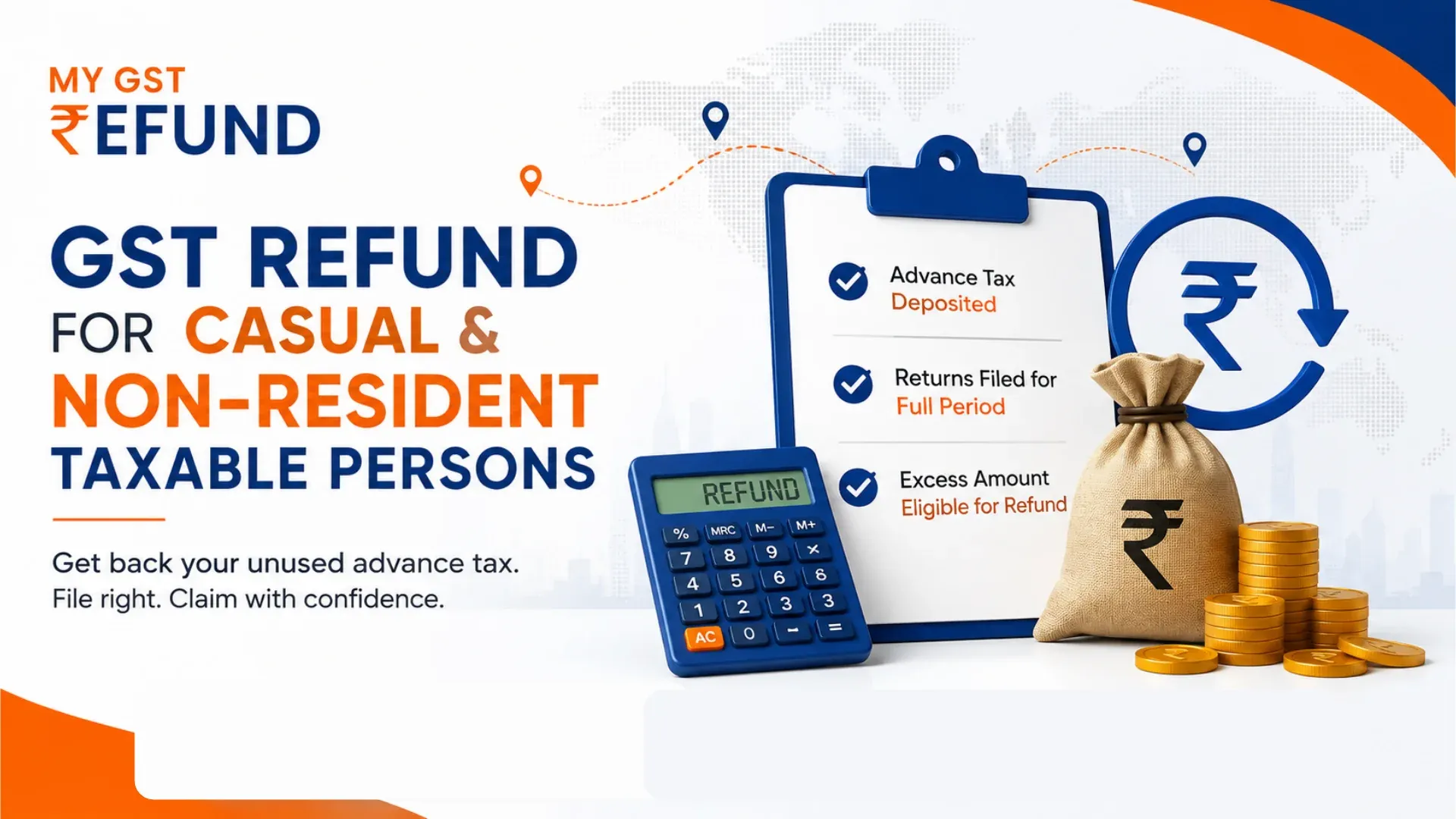
GST Refund for Casual & Non-Resident Taxable Persons
A casual taxable person (CTP) and a non-resident taxable person (NRTP) are subject to a special GST registration requirement under which they must deposit advance tax based on their estimated tax liability at the time of applying for registration. Both must deposit advance tax at the time of registration itself, based purely on an estimate, and that estimate rarely matches what actually gets used once trading begins.
The leftover amount does not vanish into government revenue by default; it becomes a refund, but only once a specific statutory condition is satisfied. This article sets out exactly when that refund becomes due, how it is calculated, and the sequence of returns that must be cleared before the money comes back.
Why Do Casual and Non-Resident Taxable Persons Pay Advance Tax?
Section 27 of the CGST Act treats these two categories differently from every regular taxpayer. A regular business registers once and pays tax as it goes.
A casual taxable person, someone occasionally supplying goods or services in a state where they have no fixed place of business, and a non-resident taxable person, a foreign entity supplying in India without a fixed establishment here, must instead deposit an amount equal to their estimated tax liability upfront, at the time of applying for registration.
This exists because both categories operate for a short, defined window, often a single exhibition, event, or short-term contract, and the government has no ongoing relationship with them to fall back on if tax goes unpaid after they exit.
The advance deposit is essentially security, held against a business presence that is temporary by design.
One platform. End-to-end GST management.
MyGST Refund gives CFOs and finance teams a single dashboard to manage:
GST Refunds - End-to-end refund processing, tracking & follow-ups
GST Litigation - Manage notices, cases & proceedings
CFO Dashboard - Real-time visibility into GST matters and financial impact
GST Compliance - Better control, reconciliation & documentationMyGST Refund - One platform for GST refunds, litigation & compliance.
When Does a GST Refund Become Due?
A refund becomes due once the actual tax liability incurred during the registration period turns out to be lower than the advance tax originally deposited.
This is common, since the original estimate is filed before any actual sales figures exist, and businesses often estimate conservatively on the higher side to avoid falling short mid-registration.
The registration certificate is valid for the period specified in the application or 90 days from the effective date of registration, whichever is earlier. On sufficient cause being shown, the proper officer may extend the registration by a further period of up to 90 days, subject to payment of additional advance tax based on the estimated liability for the extension period. Once the registration period ends and actual liability is finalised, whatever remains unused becomes refundable.
Section 54(13): The Key Condition for CTP/NRTP Refund
Section 54(13) of the CGST Act attaches one specific condition to this refund that does not apply to most other refund categories: the balance of advance tax can be refunded only after the taxable person has furnished all the returns required for the entire period for which the registration certificate was granted.
This is stricter than it sounds. It is not enough to file returns for most of the registration period, or to be current on filings up to the most recent month.
All returns required under Section 39 for the entire period for which the registration certificate remained in force must be furnished before the balance of advance tax can be refunded.
How is the CTP/NRTP GST refund calculated?
The refund amount is simply the difference between what was deposited and what was actually consumed against genuine tax liability during the registration period.
Refundable Balance = Advance Tax Deposited − Tax Liability Adjusted Against the Advance Deposit
Net tax liability here means output tax payable after adjusting eligible Input Tax Credit for the period, exactly as it would be computed for any regular taxpayer, just confined to the shorter registration window instead of a full financial year.
Which Returns Must Be Filed Before Claiming the Refund?
A non-resident taxable person does not file GSTR-1 or GSTR-3B at all. GSTR-5 non-resident refund filings serve as a combined outward supply, inward supply, and tax liability statement, and this is the return CBIC specifically checks before releasing any refund under Section 54(13).
GSTR-5 is due by the 13th of the following month, or within 7 days of the expiry of the registration validity, whichever is earlier.
How to Claim GST Refund of Unused Advance Tax?
- Ensure every GSTR-1 and GSTR-3B, for a CTP, or every GSTR-5, for an NRTP, has been filed for the full registration period, including the final period before expiry or cancellation.
- Reconcile the total advance tax deposited against the actual net liability discharged across all periods.
- File Form GST RFD-01 on the GST portal, selecting the appropriate refund category for excess balance after adjustment
- Maintain supporting computation showing the advance tax deposited, period-wise tax liability, adjustments made, and the resulting refundable balance
- Track the application through the standard refund processing timeline once filed.
GST Refund Consultant - MyGST Refund provides expert, end-to-end GST refund assistance for accurate claims, documentation, filing, and follow-ups.
GST Refund for Casual Taxable Person: Worked Example
A trader from Rajasthan registers as a casual taxable person to sell handicrafts at a 45-day trade fair in Delhi, estimating and depositing 1,20,000 rupees as advance tax.
Actual sales over the fair generate a net tax liability, after ITC adjustment, of 85,000 rupees across the GSTR-3B filings for the period.
After furnishing the applicable returns for the complete registration period and adjusting the actual tax liability of ₹85,000 against the ₹1,20,000 advance tax deposit, ₹35,000 remains as the refundable balance, subject to the applicable conditions and prescribed refund mechanism.
GST Refund for Non-Resident Taxable Person: Worked Example
A foreign equipment supplier registers as a non-resident taxable person for a 60-day machinery installation project in Gujarat, depositing 8,00,000 rupees as advance tax based on the estimated contract value.
Actual GSTR-5 filings across the two months show a combined net tax liability of 6,10,000 rupees. After furnishing the GSTR-5 returns covering the entire registration validity and adjusting the actual tax liability of ₹6,10,000 against the ₹8,00,000 advance tax deposit, ₹1,90,000 remains as the refundable balance, subject to the applicable conditions and prescribed refund mechanism.
GST Refund for CTP/NRTP: Complete Pre-Application Checklist
- The period for which the registration certificate remained in force has ended.
- Every return covering the full registration window has been filed, with no gaps.
- Actual tax liability has been reconciled against the advance tax deposit, and the refundable balance has been determined.
- The supporting computation sheet is ready, showing period-wise liability breakdown.
- The bank account linked to the GST registration is active and validated for refund credit.
Conclusion
The refund of unused advance tax for a casual taxable person GST refund or a non-resident taxable person GST refund claim is straightforward in principle but unforgiving in sequence.
Section 54(13) does not allow a partial-filing shortcut; every return for the entire registration period must be cleared first, and for an NRTP, that means every GSTR-5 without exception.
Businesses that plan their exit filings alongside their final transactions, rather than treating return filing as an afterthought once the event or contract ends, recover this money without unnecessary delay.
Frequently Asked Questions
1. Can a Casual Taxable Person get a refund of the advance GST?
Yes, once the registration period ends and all GSTR-1 and GSTR-3B returns for that period are filed, any unused portion of the advance tax deposited becomes refundable under Section 54(13).
2. Can an NRTP claim a refund of excess GST paid?
Yes. An NRTP can claim the eligible balance of advance tax after the required GSTR-5 returns covering the registration period have been furnished and the actual tax liability has been adjusted against the advance deposit, subject to the applicable provisions.
3. What happens to the unused advance tax after the CTP registration ends?
The unused balance remains available for refund after the applicable returns for the registration period have been furnished and the actual tax liability has been adjusted, following the prescribed mechanism for CTPs and NRTPs.
4. Does an NRTP have to file GSTR-5 before claiming a refund?
Yes, for an NRTP, the applicable GSTR-5 returns covering the entire registration period must be furnished before the balance of advance tax can be refunded, in accordance with Section 54(13).
5. Can I claim the refund immediately after the temporary GST registration expires?
Not necessarily immediately. The balance of advance tax can be refunded only after the applicable returns for the entire registration period have been furnished, and the tax liability has been adjusted. The eligible balance is claimed through the prescribed mechanism in the last return required to be furnished.
Related Posts