MOOWR Scheme: Eligibility, Benefits & Rules
Published on: Wed Sep 16 2026
Adv. Hetal Bansal

Bio (Reveal/Hide)
MOOWR Scheme: Eligibility, Benefits & Rules
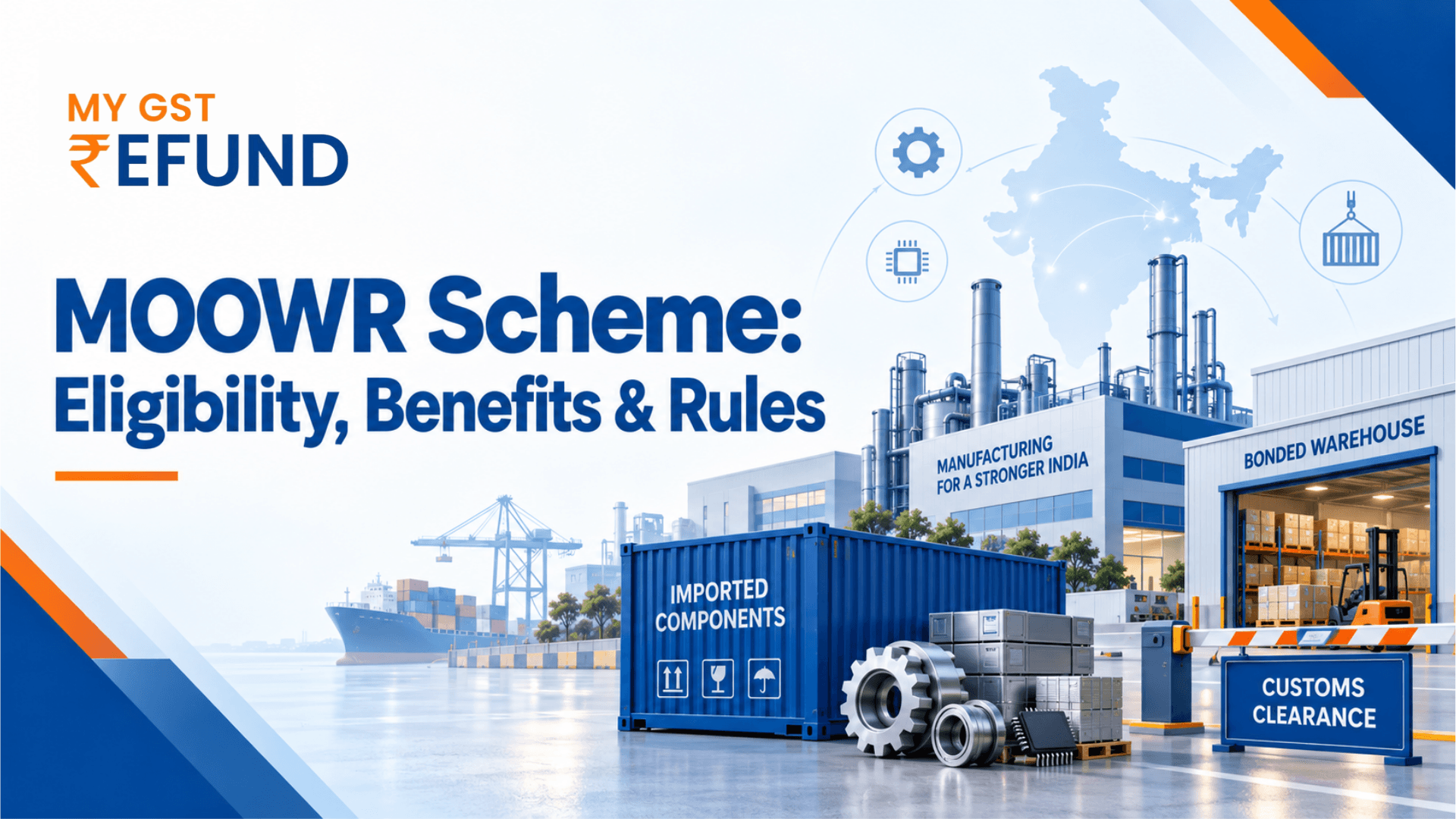
MOOWR allows eligible manufacturers to defer applicable customs duty on imported goods used for authorised manufacturing/other operations in a bonded warehouse. Treatment of duty depends on the manner in which the goods or resulting products are cleared.
This alters the whole cash-flow equation of establishing a plant in India for electronics and EV component manufacturers who are importing high-dollar, expensive capital equipment and high-value inputs.
What Is MOOWR Scheme?
MOOWR means the Manufacture and Other Operations in Warehouse Regulations, 2019, which has been notified under Section 65 of the Customs Act, 1962. It is operationalised alongside Section 58 (which governs the licensing of private warehouses) of the same Act and is codified through three distinct instruments working together.
MOOWR Full Form and Meaning
Manufacture and Other Operations in Warehouse Regulations; the "warehouse" in question is your own licensed factory, converted into a private customs bonded warehouse, not a government-run facility.
MOOWR Scheme Benefits: What Actually Gets Deferred?
- Basic Customs Duty (BCD) on imported inputs and capital goods; deferred at the time of import
- IGST on imports; deferred as well (with an important 2023 caveat covered below)
- Another major benefit for steel, chemical, and electronics importers is the Anti-Dumping Duty (ADD), Countervailing Duty (CVD), and Safeguard Duty, which were deferred.
- No interest charge on the duty deferred for goods that remain in the warehouse for any extended time; a structural benefit over conventional warehousing under Section 61.
How Duty Actually Gets Resolved?
MOOWR Eligibility India: Who Can Apply?
- Eligible manufacturers/units meeting the applicable Customs and MOOWR requirements may apply.
- No turnover threshold
- No minimum investment requirement
- MOOWR does not impose the same export-obligation/NFE framework applicable to an EOU; however, other Customs and warehousing conditions apply.
- No Net Foreign Exchange (NFE) condition
- MSMEs explicitly eligible
- Existing factories can convert to a MOOWR unit without halting production
- Available in any state; no SEZ-style geographical clustering or minimum land area requirement
MOOWR Scheme for Electronics Manufacturing
Electronics manufacturing depends heavily on imported components, PCBs, semiconductors, display modules, connectors, often carrying meaningful BCD and, in several categories, anti-dumping duty.
MOOWR lets an electronics assembler:
- Defer duty on the full import bill of components until finished goods are cleared
- Waive that duty entirely on the portion of production that's exported
- Avoid tying up working capital in duty payments during a period when the company may still be scaling production volumes
MOOWR Scheme for EV Makers: Where It Gets More Complicated?
MOOWR may be relevant to EV component and battery manufacturers, particularly businesses with significant imported inputs or capital goods, particularly for lithium-ion battery and Battery Energy Storage System (BESS) manufacturing, but this is also where the scheme is under active government scrutiny in 2026.
The BESS Duty-Deferment Concern (2026)
The Centre is currently examining concerns that BESS developers are using MOOWR to defer customs duties on imported battery systems for 10-12 years, well beyond what the scheme was designed for.
With over 43 GWh of viability-gap-funded BESS capacity already announced, officials worry this could:
- Distort India's fast-growing storage market
- Weaken the case for genuine domestic battery manufacturing
- Defer customs liabilities running into several thousand crores
As one official noted, MOOWR was designed to support manufacturing and working capital, not provide a decade-long duty advantage for largely imported, assembled project equipment.
EV and BESS manufacturers should watch this space closely; tighter conditions specific to battery storage imports are plausible in coming notifications.
MOOWR vs EOU: Which Wins for a Greenfield Plant?
For a greenfield electronics plant, the choice between MOOWR and EOU depends on factors such as domestic sales, exports, duty structure, and compliance requirements. BCD and IGST on capital equipment can be deferred indefinitely without forcing an export-first structure.
MOOWR vs SEZ: Which Is Better?
MOOWR wins on flexibility of location and conversion ease; SEZ still offers its own zero-rated supply and GST refund advantages that MOOWR doesn't replicate.
MOOWR vs EPCG and MOOWR vs Advance Authorisation
A manufacturer can, in principle, combine MOOWR with Advance Authorisation or EPCG for different cost components, though this needs careful structuring to avoid double-counting the same import under two regimes.
MOOWR Scheme Advantages and Disadvantages
MOOWR Scheme Advantages:
- No export obligation, unlike EOU/EPCG/Advance Authorisation
- No interest on deferred duty, however long the deferment period
- Existing DTA factories can convert without halting operations
- Covers BCD, IGST, ADD, CVD, and Safeguard Duty together
MOOWR Scheme Disadvantages:
- No RoDTEP or Duty Drawback benefits available on exports made from a MOOWR unit; a real trade-off for export-heavy businesses relying on those incentives
- IGST exemption on domestic clearance was removed via the Finance Bill, 2023, Section 65A, which previously allowed this, was repealed, meaning IGST now applies when finished goods move into the DTA
- Duty on capital goods isn't waived; only deferred; removal from the unit at any point still triggers full duty on original CIF value, with no depreciation benefit.
- Increasing digital compliance burden: electronic records of stock movement, duty payment, and production activity are now mandatory.
MOOWR Scheme Rules and Regulations: Compliance Obligations
- Maintain Form A digital records for all stock movements, consumption, and duty status.
- File monthly returns reconciling inputs against finished goods output
- Ex-Bond Bill of Entry filing has been streamlined to reduce operational friction
- Customs authorities now have greater discretion in monitoring MOOWR units to ensure deferment conditions are genuinely met
- Clarifications on the warehousing period have been issued to prevent misuse and ensure transparency in stock movement
MOOWR Scheme Application Process: Step by Step
- Conduct an eligibility analysis of your manufacturing operations and import profile.
- Draft and submit the application to the jurisdictional Customs Commissionerate
- Liaise with customs during document review.
- Undergo a site inspection of the proposed bonded warehouse (existing or new factory)
- Execute the required bond.
- Get the licence; this will be valid for a lifetime and will not require periodic renewal;
It normally takes 30-45 days from start to finish, depending highly on the jurisdiction and the extent to which an application is prepared.
Common Mistakes Businesses Make With MOOWR
- Assuming MOOWR fully replicates EOU-style exemptions, missing the 2023 IGST exemption removal
- Not accounting for the loss of RoDTEP/Duty Drawback eligibility when comparing net export incentives.
- Treating capital goods duty as waived rather than deferred, leading to unexpected liability on eventual removal
- Underestimating the digital record-keeping burden, risking a duty demand years later from poor reconciliation
- Using MOOWR for extended duty deferment on largely imported, assembled equipment (as flagged in the current BESS scrutiny) rather than genuine value-added manufacturing
Checklist Before Applying for MOOWR
- Confirm IEC and GST registration are active and correctly linked
- Model the actual cash-flow benefit accounting for lost RoDTEP/Drawback eligibility
- Set up digital record-keeping infrastructure before licensing, not after
- Clarify capital goods removal strategy in advance, given the no-depreciation duty exposure
- Monitor upcoming notifications if operating in battery/BESS manufacturing, given active regulatory scrutiny
Latest Updates on MOOWR (2026)
Circular No. 37/2026 (27 August 2026) reflects continued CBIC refinement of MOOWR operational procedures.
In 2026, there is active government scrutiny of BESS duty-deferment periods; scenarios for 10-12 year periods are beginning to cause concern about support for domestic production and manufacturing paths.
Digital compliance mandate continues tightening; electronic filing of stock and duty records is now a standard enforcement expectation, not optional.
Section 67 inter-warehouse transfer requirements for prior permission have been eased in recent budget cycles, reducing procedural friction for multi-unit manufacturers.
Conclusion
MOOWR remains one of the most flexible duty-deferment tools available to Indian manufacturers, especially for electronics and EV component makers weighing capital-intensive, import-heavy plants, but it's not a duty-saving shortcut.
The 2023 IGST exemption removal and the lost RoDTEP/Drawback eligibility mean the real benefit needs modelling against your actual export-to-domestic sales mix, not assumed from the scheme's headline pitch.
Frequently Asked Questions ( FAQs)
1. Can MOOWR units sell in the domestic market (DTA) without restriction?
Yes, unlike EOU, MOOWR imposes no NFE or export obligation, so domestic sales are freely allowed; duty on the imported inputs used becomes payable at the time of DTA clearance.
2. Is capital goods duty-free under MOOWR?
No, capital goods duty is deferred, not waived; it becomes payable in full, computed on the original CIF value with no depreciation benefit, whenever the capital goods are physically removed from the MOOWR unit.
3. Can an existing SEZ or EOU unit convert to MOOWR?
Conversion between these regimes involves specific procedural and eligibility conditions tied to exiting the original scheme's obligations first, so it typically requires a formal transition process rather than a direct switch.
4. Does MOOWR affect GST refund eligibility on exports made from the bonded unit?
Exports from a MOOWR unit remain zero-rated under standard GST provisions, but the loss of RoDTEP and Duty Drawback specifically (not GST refund) is the trade-off unique to this scheme.
5. What happens to deferred duty if a MOOWR unit's licence is surrendered or revoked?
Any duty deferred on inputs or capital goods still held in the unit typically becomes payable at that point, based on the stock and asset position reconciled through the unit's Form A records.
Related Posts