GST Refund for Textile Exporters: RoSCTL & Drawback Guide
Published on: Mon Sep 28 2026
Adv. Hetal Bansal

Bio (Reveal/Hide)
GST Refund for Textile Exporters: RoSCTL & Drawback Guide
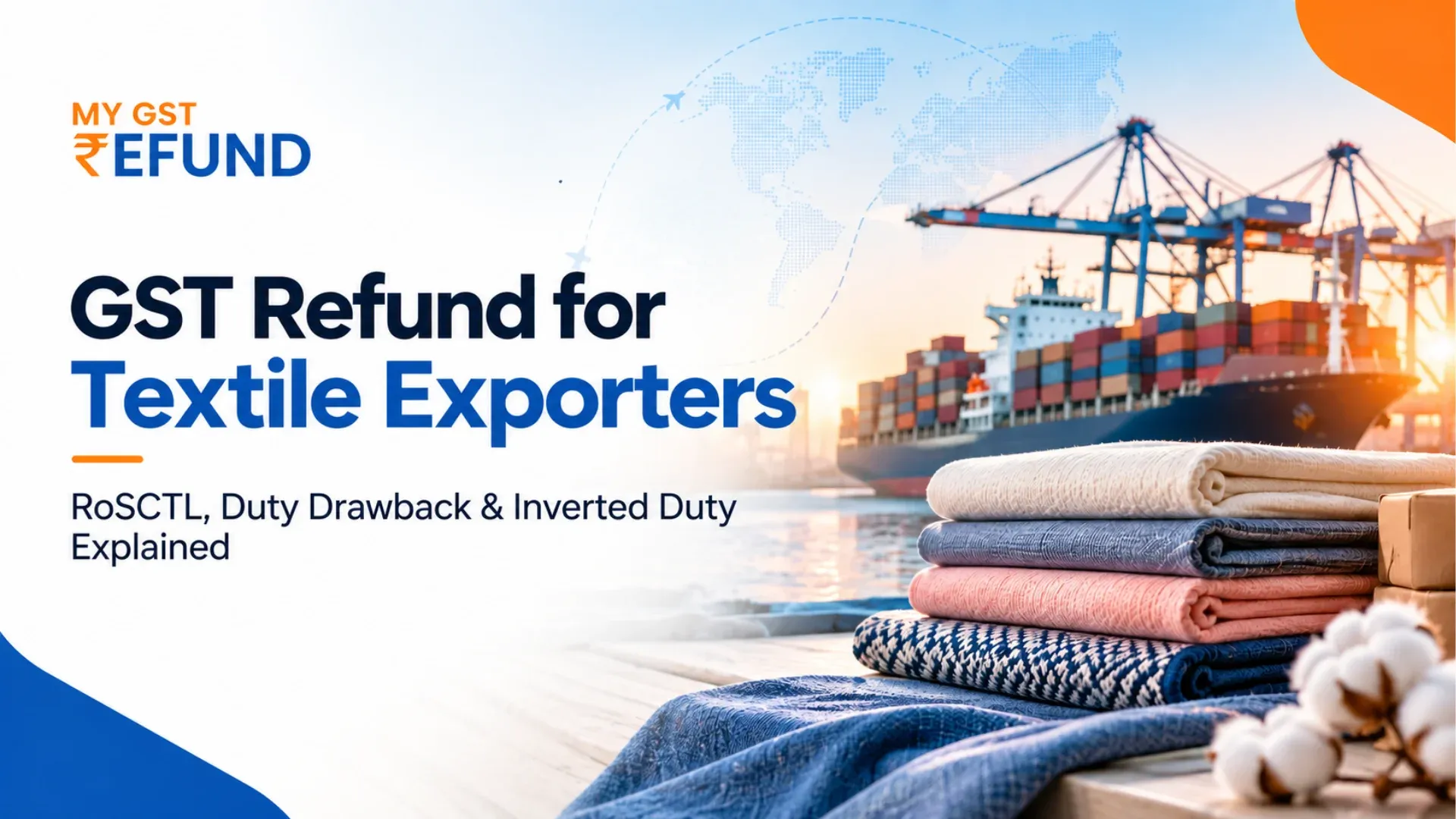
Exporters have several options for tax recovery and export incentives. GST refund for exporters, Duty Drawback, and RoSCTL have different legal regimes and are subject to different eligibility criteria. It is essential for exporters to understand the operation of each mechanism as well as how they work together to determine the opportunities offered for their export products.
Why Textile Exports Need Three Separate Claims, Not One?
Each mechanism recovers a genuinely different cost component, and understanding this separation is the first step to claiming all three correctly.
GST on Textile Exports: Starting From the Rate Structure Itself
The introduction of GST 2.0 rate rationalisation on 22nd September 2025 brought about a significant change in the workings of taxes on the textile industry, and all the exporters' refund claims considered after that date are being calculated in this new structure.
Current GST Rates on Textiles
This last row matters more than it looks; it's the reason the inverted duty structure in textiles under GST hasn't fully disappeared even after the rate correction.
Inverted Duty Structure in Textiles: What Changed and What Didn't?
Until September 2025, the classic inversion used to be applied throughout the fibre to yarn to fabric to garments segment, with rates not matching at almost every step of the process.
GST rates for specified textile products were rationalised from September 2025. The applicable rate should be checked product-wise against the relevant HSN and notification.
Where eligible inputs attract a higher GST rate than the corresponding outward supplies, an inverted duty structure may arise. Refund eligibility must be determined with reference to Section 54(3), Rule 89(5), the relevant HSNs and applicable conditions.
Eligible unutilised ITC arising from an inverted duty structure may be refundable under Section 54(3) read with Rule 89(5), subject to the applicable conditions and exclusions.
GST Zero-Rated Supply for Textile Exporters: The Underlying Framework
Like any export, textile shipments qualify as zero-rated supply under Section 16 of the IGST Act, regardless of the domestic GST rate that would otherwise apply.
Exporters file a Letter of Undertaking (LUT) for textile export through Form GST RFD-11 exactly as any other exporter, valid for the financial year.
RoSCTL Scheme for Textiles: What It Actually Covers?
RoSCTL (Rebate of State and Central Taxes and Levies), operational since 7 March 2019, exists specifically to refund the taxes GST never touches at all: VAT on captive fuel, electricity duty, mandi tax on raw cotton, and similar embedded state and central levies.
RoSCTL Rate List for Garments and Made-Ups
Eligible RoSCTL benefits are issued electronically as duty credit scrips/e-scrips in accordance with the applicable scheme and customs procedures.
DGFT RoSCTL Online Application Process
- File the shipping bill with the RoSCTL claim flagged at the time of export
- E-scrips are generated electronically and credited through ICEGATE, without a separate standalone application form
- Remove unless you cite the specific current RoSCTL notification/procedure supporting this statement.
Is RoSCTL Applicable on Fabric Exports?
RoSCTL coverage is prescribed for eligible products falling within the tariff items/categories covered by the prevailing RoSCTL scheme. Eligibility should be checked against the applicable tariff classification and notification.
Standalone fabric exports should be checked against the prevailing RoDTEP schedule and applicable tariff-item conditions; they should not automatically be described as RoDTEP-eligible
Difference Between Duty Drawback and RoSCTL
Can I Claim Duty Drawback and GST Refund Simultaneously?
Yes, on the same export, there may be two components of tax: one by Duty Drawback (customs duty on inputs) and the other by GST refund (unutilised ITC), which are different, and the exporter must ensure that the same tax/duty component is not claimed twice and that all applicable restrictions and conditions are satisfied.
How to Claim RoSCTL and GST Refund Together?
- Confirm your product falls under Chapters 61, 62, or 63 for RoSCTL eligibility.
- File the shipping bill flagging the RoSCTL claim, letting the e-scrip generate through ICEGATE.
- Separately, file LUT (Form RFD-11) for zero-rated GST treatment on the same export
- File Form RFD-01 for the GST refund of unutilised ITC, following the standard Rule 89(4) formula
- Where the same consignment also involves Duty Drawback, ensure the correct drawback schedule rate is applied alongside, since RoSCTL and Drawback aren't mutually exclusive; both claims proceed independently.
How to Calculate Duty Drawback for Textile Exports?
Duty Drawback for exporters of textiles is subject to the notified schedule of rates of drawback known as “All Industry Rate” (AIR), which varies by HS code, like the other Drawback schemes.
Check the latest rules and regulations before publishing the specific two-month period of Customs or Drawback.
A Worked Calculation Example
An exporter of garments exports apparel valued at ₹50,00,000 (FOB) under Chapter 62 with values exceeding ₹2,500 per garment, which falls in the 18% domestic GST slab, but the export of apparel remains zero-rated.
Exporters should separately evaluate GST refund, Duty Drawback and applicable export incentives to identify the benefits available for their specific exports.
Textile Export Documentation Checklist India
- GSTR-1 and GSTR-3B for the claim period
- LUT copy (Form RFD-11), current for the financial year
- Shipping bill with RoSCTL flag and correct HS chapter classification
- Statement-3/3A for GST refund, invoice-wise
- For export of goods, use the applicable shipping bill/export documentation and GST refund requirements. Do not present FIRC/BRC as a universal requirement for goods-export refunds.
- Duty Drawback documentation (AIR schedule reference or Brand Rate application, where applicable)
How to Clear Stuck GST Export Refunds on ICEGATE?
ICEGATE shipping bill GST refund tracking is where most textile exporters first notice a claim has stalled, usually traced back to a shipping bill-to-GSTR-1 mismatch, an unlinked AD Code, or a bank validation failure at the PFMS stage.
Checking both the GST portal's refund status and ICEGATE's own tracking module, rather than just one, catches issues faster.
Exporters can also use a GST Refund Report Card to review potential refund-related issues.
Are RoSCTL Scrips Taxable Under GST?
Do not publish this without a specific legal opinion/source. The GST treatment of transfer/sale of duty credit instruments should be separately examined.
Common Mistakes Textile Exporters Make
- Assuming RoSCTL alone represents the "full" export benefit, missing the separate GST refund entirely
- Filing RoSCTL claims on fabric-only shipments outside Chapters 61-63, where the scheme doesn't apply.
- Failure to monitor the accumulation of inverted duty at the 18% rate charged on petrochemical feedstocks even after the September 2025 correction in the fibre-yarn-fabric duty.
- The nuance here is that if a piece of clothing is just over the limit of ₹2,500, it will be taxed at 18 % on the entire value of the item and not on the amount exceeding ₹2500.
Checklist Before Filing GST for Textile
- Confirm HS chapter classification determines RoSCTL vs RoDTEP eligibility correctly.
- File LUT and RFD-01 separately from the RoSCTL/Drawback claims, not assuming they're bundled.
- Check for inverted duty ITC specifically tied to petrochemical-derived inputs.
- Perform GST reconciliation of shipping bill data against GSTR-1 before filing to avoid ICEGATE mismatches.
Latest Updates for Textile Exporters
- RoSCTL extended to 30 September 2026, with the government actively weighing a further extension, possibly aligned with the 16th Finance Commission cycle, following CITI's request for a 5-year extension and a doubled outlay from ₹5,000 crore to ₹10,000 crore.
- For MMF manufacturers, the upstream petrochemical feedstock inversion was retained in GST 2.0 rationalisation (22 September 2025) despite the fibre-yarn-fabric inversion being remedied.
- The 50% U.S. rate remains a talking point with industry groups, and continuity of RoSCTL and Drawback processes takes on real significance for apparel exporters' margins in 2026.
Conclusion
GST refund, Duty Drawback and RoSCTL should be treated separately by the textile exporters, with independent eligibility requirements and processes. In order to claim a benefit, product classification, the applicable notifications, shipping-bill declarations, eligible ITC, and the nature of the export transaction all ought to be considered.
For exporters, a GST-wise reconciliation of shipping bills and applicable export incentives with GST data can help in the identification of the claims and minimize the chances of any documentation or classification-related problems.
Frequently Asked Questions (FAQs)
1. Is it necessary to obtain separate registrations at DGFT and GST portal for an exporter to avail RoSCTL and GST refund?
No, both are different processes; only having an IEC and GSTIN is required. No separate registration is required for filing of RoSCTL in the shipping bill via ICEGATE, or for filing a GST refund in the GST portal via Form RFD-01.
2. Can a product with a made-up of over ₹2,500 be offered at 6.05% RoSCTL, even if it is subject to 18% domestic GST?
Yes, RoSCTL eligibility is based on HS chapter classification (Chapter 63 for made-ups) and not the GST slab the product attracts if sold in India, and complete export is considered zero-rated too.
3. What would be the consequences of a textile exporter applying for RoDTEP but not RoSCTL for a garment shipment?
As RoSCTL and RoDTEP are not interchangeable, a RoDTEP claim in error for those HS chapters that also require RoSCTL may normally have to be corrected with the department.
4. Is there a minimum export value required to claim RoSCTL on a shipment?
There is no minimum FOB value specified for its eligibility as a RoSCTL claim; however, for very low-value shipments, some documentation issues may apply, as in most other export incentive claims.
5. Can accumulated RoSCTL e-scrips be used to pay GST liability, or only customs duty?
RoSCTL e-scrips are specifically designed for customs duty payment or transfer/sale to another importer, and are not usable for settling GST liability, which follows its own separate payment and refund mechanisms.
Related Posts