Refund Voucher Under GST: Rules, Format & GST Reversal
Published on: Mon Aug 17 2026
Adv. Hetal Bansal

Bio (Reveal/Hide)
Refund Voucher Under GST: Reverse GST on Refunded Advance
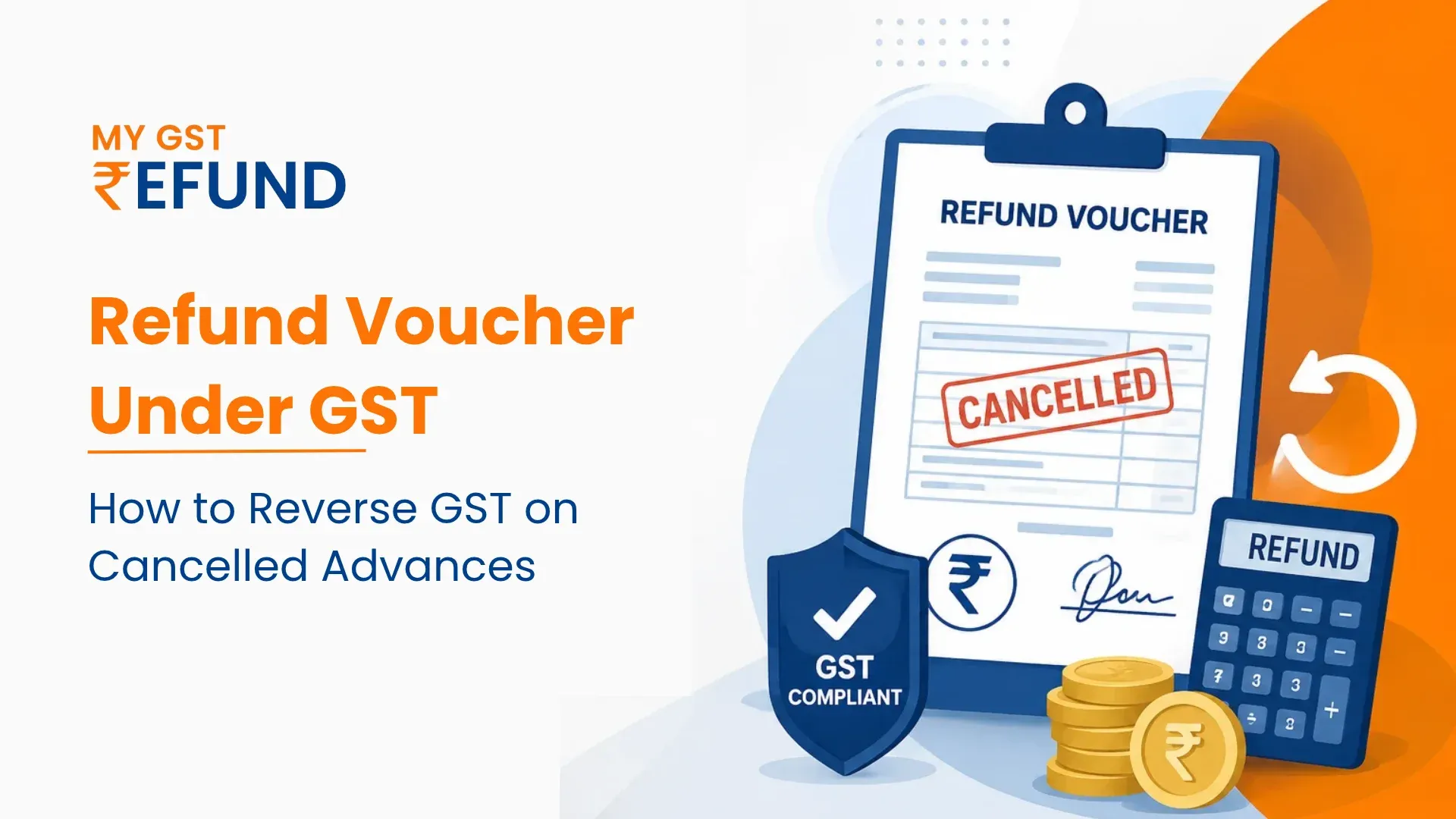
Received an advance, paid GST on it, and then the client cancelled before you delivered anything? This is exactly where a refund voucher under GST comes in, and most businesses either skip it entirely or try to fix the mismatch by simply issuing a credit note, which is the wrong document for this situation.
The confusion arises because no invoice was ever raised for that advance, so the usual credit note route under Section 34 technically does not apply. This guide explains what a refund voucher actually is, when to issue one, and how to correctly reverse the GST paid on advance so your GSTR-1 and GSTR-3B stay clean.
If your business needs help with GST refunds, our experts at MYGST Refund can review your filings, identify discrepancies, and help you claim the refund you’re eligible for - accurately and efficiently.
What Is a Refund Voucher Under GST?
Under GST, a refund voucher needs to be issued by a supplier when the advance is received, a receipt voucher has been raised, GST has been paid on the advance, but the actual supply didn't take place, and the supplier didn't raise a tax invoice against the advance.
It documentally acknowledges that the advance is returned to the customer and that the GST amount already paid on the advance is outstanding.
When Should You Issue a Refund Voucher Under GST?
You must issue a refund voucher under GST specifically when all three conditions are met together, not just one of them.
- An advance was received against a future supply.
- A receipt voucher was issued, and GST was paid on that advance.
- The supply was subsequently cancelled or did not go ahead, and no tax invoice was ever raised against it.
Where an invoice has been issued before cancellation, you should make a credit note and not a refund voucher because the document issued depends on the existence of an invoice.
Receipt Voucher vs Refund Voucher: What's the Difference?
Think of these two documents as a pair. A receipt voucher opens the tax liability on an advance, and a refund voucher for a cancelled order closes it out when the deal falls through.
GST on Advance Payments: Does the Treatment Differ for Goods and Services?
Yes, and this is a distinction many businesses get wrong even years into GST compliance.
- For services, GST must still be paid at the time of receiving an advance, under Section 13(2) of the CGST Act, since the time of supply for services is triggered by receipt of payment.
- For goods, GST is no longer payable at the time of receiving an advance. In Notification No.66/2017-Central, all registered persons, other than composition taxpayers, were exempted from tax on the advance received for the future supplies of goods.
So, in practice, a refund voucher for GST situations does not happen as much with goods, as it does with services, because the supplier of goods will rarely have paid GST on the advance in the first place, and if the goods that were ordered are then cancelled, there's no advance to unwind.
Mandatory Particulars of a GST Refund Voucher Under Rule 51
A refund voucher is not a free-form document. Rule 51 prescribes specific fields it must contain.
- Name, address, and GSTIN of the supplier
- A consecutive serial number, unique for the financial year
- Date of issue
- Name, address, and GSTIN or UIN of the recipient, if registered
- Number and date of the original receipt voucher issued against the advance
- Description of the goods or services for which the advance was received
- Amount of refund made to the recipient
- Rate of tax, IGST, CGST, SGST, UTGST, or cess, applicable
- Amount of tax reversed under each head.
- Signature or digital signature of the supplier or an authorised representative
GST Refund Voucher Format: Sample Template
This GST refund voucher format applies to an intra-state transaction. For an inter-state advance, the same fields apply but with IGST reversed instead of the CGST-SGST split.
How to Report the Refund Voucher in GSTR-1?
The refund voucher itself is not separately uploaded as a line item the way an invoice is. Instead, the reversal is reflected in Table 11B of GSTR-1, Advances Adjusted, where the previously reported advance in Table 11A is now shown as adjusted, effectively netting off the earlier liability.
No invoice is created for this transaction; therefore, there is no entry in the B2B or B2C invoice tables.
How Does the Refund Affect GSTR-3B?
In GSTR-3B, the reversal reduces the net outward tax liability for the period in which the refund voucher is issued, since the earlier advance had already inflated liability in the period it was received.
Practically, this means the tax paid on the advance effectively gets adjusted against your current period's output liability, rather than sitting as a separate standalone refund claim.
Do You Need to File RFD-01 to Get the GST Back?
In most cases, no. The supplier does not have to apply for a cash refund of the GST paid on advance refund, as the same will be reflected in the next GSTR-3B.
If the supplier does not have the necessary output tax liability for that period or for subsequent periods, or if such output tax liability is insufficient (in either case), the claim for a refund of any excess balance in the electronic cash ledger may be filed separately on Form GST RFD-01.
Can an Unregistered Person Claim a GST Refund?
An unregistered customer cannot personally file a GST refund claim with the department, since GST refund provisions apply to registered persons.
Where an unregistered person paid an advance that included GST and the order was cancelled, it is the registered supplier's responsibility to issue the refund voucher, refund the full amount including tax, and adjust their own liability accordingly.
The unregistered customer's recourse is entirely through the supplier, not through a direct claim to the GST department.
Practical Example: GST Paid on Advance but Order Is Cancelled
In July 2026, a consulting firm in Mumbai gets an advance amount of Rs. 1,00,000 for a project; they issue a receipt voucher, and they pay 18% GST on this advance in the GSTR-3B for the month of July 2026.
Before an invoice is issued, in August of 2026, the client will terminate the contract.
The firm has issued a refund voucher for Rs. 1,18,000 and refunded the client in full while simultaneously adjusting the amount of net GST liability of the firm in Table-11B of the August GSTR-1 due to that adjustment, instead of making a separate claim for refund.
Common Mistakes When Handling GST Refunds on Advances
- Issuing a credit note instead of a refund voucher when no tax invoice was ever raised
- Forgetting to reference the original receipt voucher number on the refund voucher
- Not reporting the adjustment in Table 11B of GSTR-1, leaving the earlier advance liability unreversed on record.
- Assuming GST was payable on an advance for goods when Notification No. 66/2017 exempted it
- Filing RFD-01 unnecessarily when the reversal could simply be adjusted against current output liability
Conclusion
A refund voucher under GST exists precisely for the gap between paying tax on an advance and never actually delivering the underlying supply, and using the wrong document, typically a credit note, is the single most common error businesses make here.
Getting the Rule 51 particulars right, reporting the adjustment correctly in Table 11B, and knowing when RFD-01 genuinely becomes necessary keeps this reversal clean rather than creating a mismatch that surfaces months later during GST reconciliation.
Frequently Asked Questions
1. What are the types of refund under GST?
GST refunds broadly cover export and SEZ supplies, inverted duty structure, excess balance in the electronic cash ledger, deemed exports, and adjustments like the refund voucher route for advances where the underlying supply never took place.
2. How to apply for a refund voucher under GST in India?
A refund voucher is not "applied for" through the GST portal; it is issued directly by the supplier under Rule 51, containing the prescribed particulars, and the resulting tax reversal is reported through GSTR-1 and GSTR-3B.
3. What is a refund voucher under GST, and when is it issued?
It is a document issued under Rule 51 when an advance was received, GST was paid on it through a receipt voucher, and the supply was subsequently cancelled before any tax invoice was raised.
4. What are the conditions to claim a refund voucher under GST?
The advance must have been received with GST paid via a receipt voucher, and the supply must not have proceeded to the invoice stage, since a refund voucher only applies where no tax invoice exists for that transaction.
5. Where can I download the official form for requesting a GST refund voucher?
There is no separate downloadable government form for a refund voucher, since it is a self-generated document the supplier prepares containing the Rule 51 particulars, typically through their own accounting or GST invoicing software.
Related Posts