57th GST Council Meeting Update: Key Decisions
Published on: Sat Oct 10 2026
Adv. Hetal Bansal

Bio (Reveal/Hide)
57th GST Council Meeting 2026: Key Recommendations, Explained
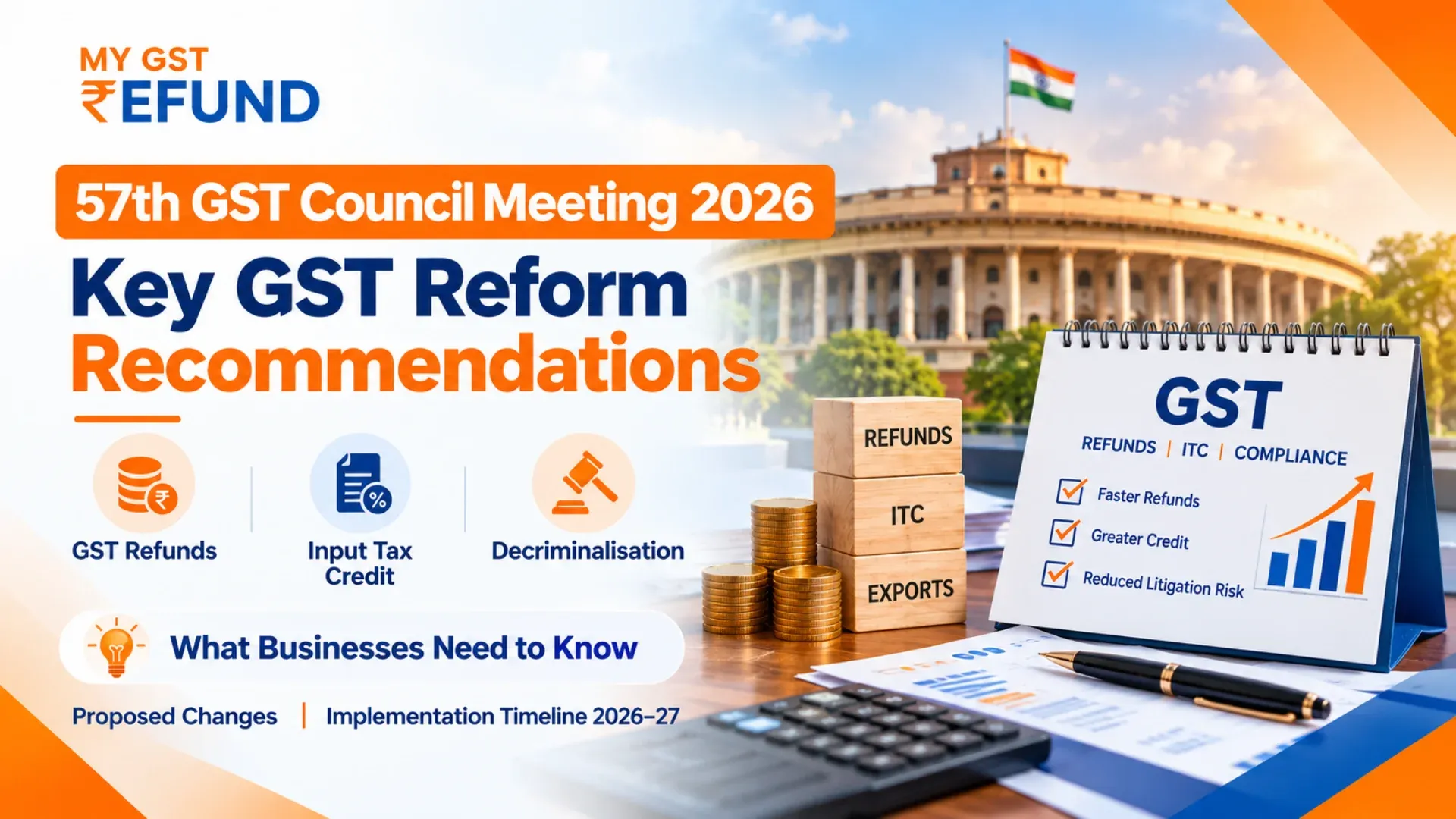
Why can genuine exporters face delays in GST refunds, while certain tax disputes involving alleged offences can expose businesses to prosecution and other enforcement action? To address exactly this imbalance, the 57th Meeting of the GST Council was held on 8 October 2026.
The issue is not about the tax rate. It has been the process around it: manual refund checks, blocked credits on routine business costs, and criminal exposure for disputes that are really about interpretation.
This time, the Council did not announce a broad restructuring of GST rate slabs, but recommended specific rate clarifications and exemptions. Rather, the changes were recommended in refunds, Input Tax Credit, penalty, prosecution, returns, and exports. Here are the details behind each of these decisions, the part of the law each one alters, and the year when you're likely to see it in action.
The 57th GST Council Meeting at a Glance
For most, it is best to view the key facts first. The meeting itself had an unusual run-up, which explains why the agenda carried so much weight.
Why Was This GST Council Meeting Different?
The 56th meeting in September 2025 rebuilt the rate structure into 5% and 18% slabs, with a 40% rate for demerit goods.
With rates settled, the Finance Minister told reporters that the Council has turned to "how the tax works day to day." She also said rate changes will now be taken up only once a year.
- Rates were the 2025 story. Process is the 2026 story.
- The Council recommended different implementation timelines for different measures. The proposed return-matching changes are linked to the April 2027 return, while other recommendations will depend on their specified dates and the relevant notifications or legislative amendments
- Till the issuance of a notification by CBIC or an amendment in the Act, nothing changes.
Given that premise, the very first and most beneficial reform is refunds: money that is stuck.
Refund Reforms: The Working Capital Fix
Small exporters and manufacturers are hard hit by GST refunds. The recommendations of the 57th GST Council Meeting are designed for both on the speed of processing of refunds and the extent of what can be returned.
The Problem and Why It Happens
A copy of the claim for a refund (Form RFD-01) has been placed on an officer for acknowledgement, examination, and a provisional order. The most common reasons for delay are:
- Scanned documents that an officer must read manually.
- Deficiency memos issued late in the 15-day window, which resets the clock.
- A narrow refund formula under Rule 89(5) that ignores credit on input services and capital goods.
That last point matters. In Union of India v. VKC Footsteps (2021), the Supreme Court upheld the exclusion of input services from inverted duty refunds, and only the Council could change it.
What the Council Recommended?
In Phase 2, fully risk-cleared export refunds will be sanctioned in full by the system, net of pending dues. According to briefing figures, about 65% of refund claims relate to exports or inverted rates, and 55% of those are already rated low risk.
57th GST Council Meeting ITC Rules: What Becomes Claimable
Section 17(5) of the CGST Act blocks credit on several costs that businesses incur for genuine commercial reasons. The Council has recommended opening up a meaningful part of that list.
Blocked Credits Being Relaxed
If implemented as recommended, the proposed ITC relaxations for eligible free samples and goods written off due to legally mandated shelf-life expiry could reduce credit reversals for certain FMCG, pharmaceutical and food businesses.
Limited Credit in the Same Line of Business
Restaurants, outdoor catering, hotels charging up to ₹7,500 per unit per day, and gyms currently pay 5% without credit.
The Council has recommended limited credit where a business buys and resells the same service, as already allowed for tour operators and passenger transport.
New Eligibility Rules for Input Tax Credit Through Returns
From the return for April 2027, the Council has proposed a cleaner link between GSTR-1, GSTR-2B, the Invoice Management System (IMS) and GSTR-3B:
- Rule 61(1A): corrects liability so that GSTR-3B matches GSTR-1, GSTR-1A or IFF.
- Rule 61(1B): corrects ITC, which aligns GSTR-3B with GSTR-2B.
- Rule 60(6A): formalises IMS accept, reject, and pending actions, with a time limit for keeping credit notes pending.
- Rules 86C and 86D: new electronic statements for credit reversal and reclaim, and for RCM tax paid against ITC claimed.
- Form DRC-03: will capture invoice-level information of the voluntary payments.
These mechanics first undergo public consultation, and modifications by the Finance Minister can be made based on the feedback.
The Genuine Buyer Question
Under Section 16(2)(c), a buyer loses credit if the supplier fails to pay tax, even when the buyer holds an invoice, has received the goods, and paid in full. The Council has formed a Committee of Officers to design safeguards, with a report due within three months.
A key compliance practice is to reconcile ITC at invoice level rather than relying only on aggregate totals. This helps businesses identify mismatches and investigate potentially ineligible credits. Invoice-level reconciliation between purchase records, GSTR-2B and the relevant supplier filings will remain important for ITC compliance. The Council has also proposed changes to the return-matching framework and constituted a committee to examine safeguards for genuine buyers. Credit relief, however, means little if a dispute can still turn into a prosecution, which is where the third set of changes comes in.
GST Decriminalisation: Arrest, Prosecution and Penalties
This is the headline reform of the GST Council Meeting October 2026, and the one most widely reported. It moves GST closer to a civil tax system.
Section 69 GST Arrest Powers Amendment
The GST Council recommended omitting Section 69 of the CGST Act as part of its proposed decriminalisation measures. The recommendation should not be treated as effective law until the necessary legislative changes take effect
The Supreme Court, in its judgment in Radhika Agarwal v. Union of India, upheld these powers and yet imposed some protections. The Council has now gone further than the Court required.
Proposed Increase in the GST Prosecution Threshold to ₹5 Crore
The proposed amendments seek to narrow the scope of GST prosecution, particularly in relation to specified offences. The legal consequences of any dispute will depend on the final amendments and the facts of the case.
New GST Penalty Changes 2026
Pending notices and appeals below ₹10,000 will be treated as if the threshold applied from the start. A new circular will also guide officers on the quality of notices and on natural justice.
The Council recommended procedural safeguards for cases involving the blocking of electronic credit ledger balances under Rule 86A, including an opportunity for taxpayers to present their objections and receive a personal hearing, as provided under the proposed framework. If you have a pending notice, our GST notice and technical reply support can check whether it falls below the new threshold.
Enforcement relief also extends to goods on the road, which is the next part of the reform package.
E-Way Bills and Goods in Transit
Transporters often face repeat checks in every State a truck crosses. Sections 68, 129 and 130 are being amended to stop that.
- Interception only on specific intelligence, approved by a Joint Commissioner or above.
- Inspection, detention or seizure only in the supplier's or recipient's State.
- No action in transit States, unless there is no e-way bill or no proof of origin and destination.
- Section 130 confiscation will not apply merely because goods are in transit.
Small and digital businesses get their own set of changes, covered next.
Relief for Small Taxpayers and E-Commerce Sellers
Many of the GST Council meeting's key highlights are aimed at businesses with turnover under ₹5 crore.
GST Scheme for Turnover Under ₹5 Crore: ARQP Explained
The Council approved in principle a concept note for an optional Annual Return Quarterly Payment (ARQP) scheme.
It is meant for businesses with aggregate turnover up to ₹5 crore in the previous year that supply only to unregistered buyers (B2C).
The scheme's detailed rules and start date have not been announced yet.
Other Small Business and Registration Changes
The Council recommended a late-fee relief measure for eligible taxpayers with turnover of up to ₹5 crore who file the specified Section 39(1) returns within the proposed qualifying period. The exact scope and conditions should be confirmed from the relevant notification.
- Auto-approved amendments: All field amendments other than principal place of business. Even those receive auto-approval for low-risk Rule 14A registrants.
- The Council recommended simplifying the cancellation process for eligible taxpayers who have filed the required returns and paid outstanding dues, subject to the prescribed conditions and implementation rules.
- E-commerce GST registration rules 2026: a new Rule 14B lets small sellers register in another State using the e-commerce operator's warehouse as the principal place of business, if ITC passed on stays within ₹2.5 lakh a month.
For a new registration, our GST registration service can assess whether you qualify for the faster route.
E-Invoicing for RCM Transactions
The Council recommended extending e-invoicing requirements to specified reverse-charge transactions involving supplies from unregistered persons and imports of services for eligible businesses with aggregate turnover of ₹5 crore or more. The final scope and effective date should be checked against the applicable notification. This means the self-invoice under Section 31(3)(f) will need an IRN, so ERP systems need configuring now.
Exporters of services also have a lot to gain, and their changes are the most technical of all.
Export of Services and Place of Supply Changes
The Council recommended amendments to the IGST Act that could expand export-of-services eligibility and affect the GST treatment of certain cross-border transactions, subject to legislative implementation.
A circular will also clarify which foreign exchange and permitted INR receipts count as export proceeds. Exporters can check eligibility through our export refund service.
Alongside the big reforms, the Council also cleared a list of rate clarifications.
Rate Clarifications and Exemptions
The Council also recommended omitting Rule 96(10) with effect from 23 October 2017, following a Supreme Court ruling. Exporters who lost IGST refunds under that rule should review old claims.
With every decision covered, the practical question is when each one takes effect.
GST Council Decisions: Implementation Date 2027 and Beyond
Budget 2027 GST Amendments
Without Section 69 or a higher Section 132 limit, Parliament will have to call for a review. Proposals requiring amendments to the CGST Act or IGST Act will need the applicable legislative process. The timing and route of implementation should not be assumed until the government introduces the relevant legislation.
Rules and rate changes can come earlier through CBIC notifications. Watch CBIC's GST notifications and circulars for the CBIC circulars from October 2026 onwards.
Next GST Council Meeting Date 2026
No date has been announced. The Committee of Officers on genuine buyers has three months to report, and the Finance Minister indicated the Council will meet after that.
Conclusion
The 57th GST Council meeting recommended significant changes to GST refund processing, ITC, enforcement and compliance procedures. If implemented, these measures could reduce administrative friction, improve working-capital management and provide greater clarity for taxpayers. Businesses should monitor the relevant notifications and prepare their records and reconciliation processes in advance. The highest rewards for most businesses will be quicker refunds, greater credit, and reduced risk of litigation. But each advantage is rooted in clean information and accurate timeliness.
MYGST Refund helps eligible businesses assess GST refund opportunities, manage claim preparation, and track the refund process. For eligible refund services, our No Success, No Fees model means fees are payable only when the refund is successfully received, subject to the applicable engagement terms
Frequently Asked Questions (FAQ’s)
1. What are the key recommendations of the 57th GST Council Meeting?
The main recommendations are automated 90% provisional refunds, refunds of ITC on input services and capital goods, and relaxed blocked credits. They also include removing arrest powers, raising the prosecution threshold to ₹5 crore, and a ₹10,000 minimum for notices. Return matching, e-way bill checks, registration, and export rules also change.
2. Is there any change in GST rate slabs in the October 2026 meeting?
No. The Finance Minister confirmed that no GST rates changed. The Council only issued clarifications and exemptions, such as a nil rate for psyllium seeds.
3. What is the new prosecution limit under GST?
The Council recommended raising the Section 132 threshold from ₹1 crore to ₹5 crore. It also narrowed the offences, so disputes over interpretation do not lead to prosecution.
4. Who chaired the 57th GST Council Meeting?
Union Finance Minister Nirmala Sitharaman chaired the meeting at Bharat Mandapam, New Delhi, on 8 October 2026. State and UT Finance Ministers attended.
5. How does the new GST scheme benefit small taxpayers?
The proposed ARQP scheme would let B2C businesses with turnover up to ₹5 crore file one annual return and pay tax quarterly. Small taxpayers also get a late fee waiver and faster registration.
6. When will the 57th GST Council Meeting decisions be implemented?
Input service refunds apply to ITC availed from 1 November 2026. Most process reforms are expected from 1 April 2027. Law changes will need Parliament, most likely through Budget 2027.
Related Posts