GSTN Advisory 2026: Mandatory Ship-to GSTIN & EWB Closure
Published on: Thu Jun 18 2026
Adv. Hetal Bansal

Bio (Reveal/Hide)
GST Advisory on Ship-to GSTIN Capture & e-Way Bill Closure
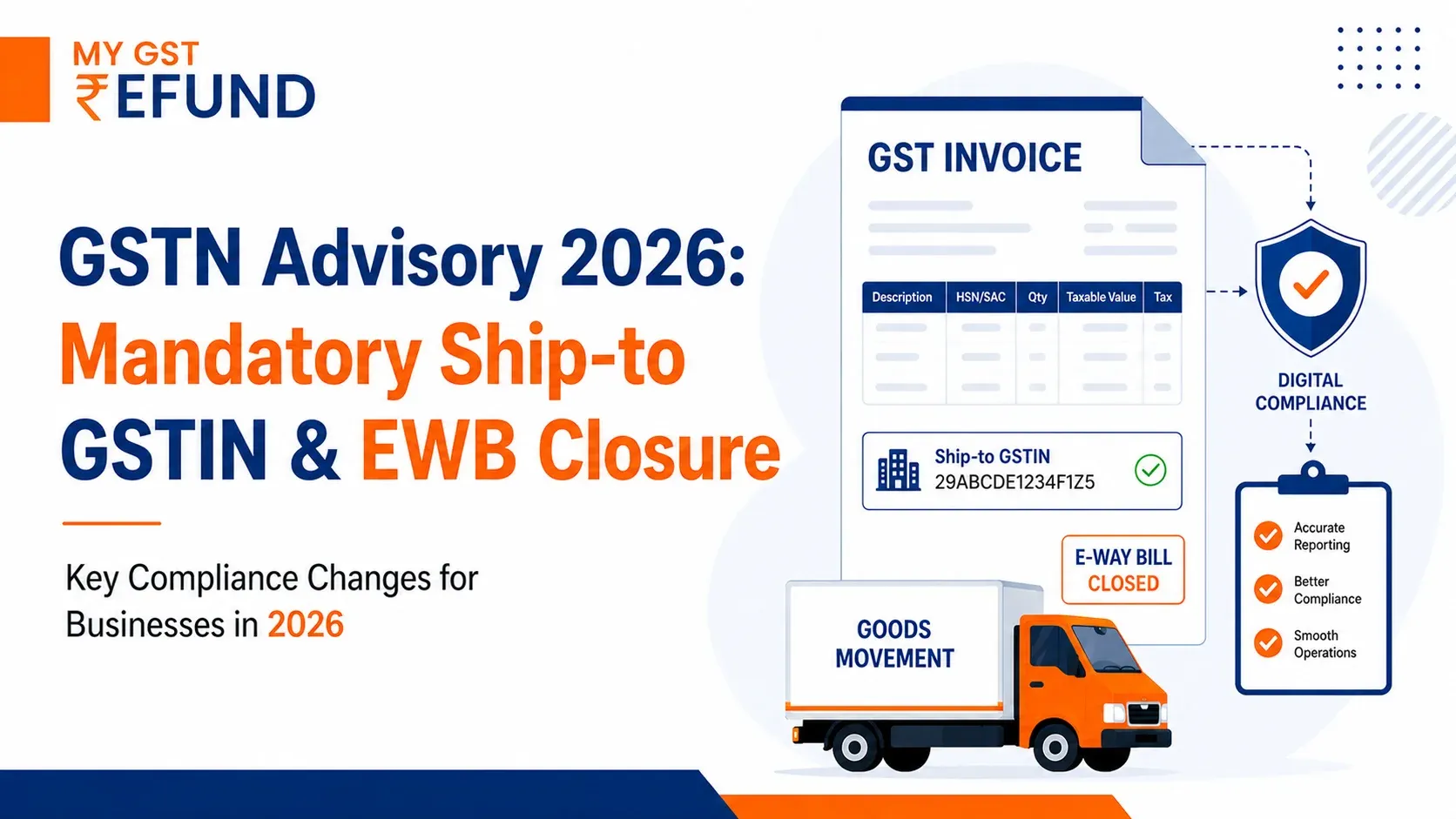
GSTN issued a critical advisory on 17th June 2026, introducing two major compliance changes: mandatory capture of Ship-to GSTIN in all Bill-to/Ship-to transactions where an e-Way Bill is generated, and a new voluntary closure of the e-Way Bill facility.
These changes directly impact taxpayers, ERP vendors, GSPs, ASPs, and private IRPs across India. Failure to update your systems on time may result in rejection of e-Invoices and e-Way Bills, leading to disruption and loss of compliance in your supply chain.
What the GSTN Advisory Dated 17 June 2026 Covers
This advisory builds on the earlier GSTN circular from 20th May 2026, which first introduced the Ship-to GSTIN requirement.
Following representations from trade bodies and system integrators seeking clarity on e-Invoice and IRN-based e-Way Bill flows, GSTN has now issued detailed implementation guidance.
The advisory covers the following key areas:
- Changes in the e-Invoice API for generating IRN and e-Way Bill together
- Changes in the e-Way Bill by IRN API
- GSTIN validation rules for Ship-to parties
- Use of "URP" for unregistered consignees
- Treatment for Export, B2B, and SEZ transactions
- Voluntary Closure of the e-Way Bill facility and its API
Mandatory Ship-to GSTIN: What Has Changed
Until now, taxpayers could generate an e-Way Bill by providing the consignee's address without their GSTIN. That changes from 1st August 2026.
Changes in Generating IRN and e-Way Bill Together
When generating an IRN along with an e-Way Bill in the same API call, the field ShipDtls.GSTIN is now conditionally mandatory.
This applies whenever:
- Ship-to Legal Name and Ship-to Address are provided in the e-Invoice schema
- e-Way Bill generation is also requested in the same transaction
If the consignee does not have a GSTIN, enter "URP" in the Ship-to GSTIN field.
Changes in e-Way Bill by IRN API
A new mandatory field "Gstin" has been added under "ExpShipDtls" in the e-Way Bill by the IRN API. Additionally, an optional field "TrdNm" (Trade Name) has also been introduced.
Key point: This field is mandatory. Systems that do not transmit Ship-to GSTIN or "URP" will face API rejection from 1st August 2026.
GSTIN Validation Rules You Must Know
GSTN has introduced strict system validations for the Ship-to GSTIN field. Here is how the system will treat different scenarios:
Additional validations include:
- Ship-to State Code must match GSTIN State Code
- Ship-to PIN Code must belong to the Ship-to State Code
- Bill-to and Ship-to parties must be distinct persons
Error Codes Introduced in Sandbox
GSTN has already released these validations in the Sandbox environment. The following error codes are now active:
Generate IRN and e-Way Bill Together
e-Way Bill by IRN
Transaction-Specific Treatment: Export, B2B, and SEZ
Different GST transactions, such as exports, B2B supplies, and SEZ transactions, have distinct reporting and tax treatment requirements, making accurate classification essential for compliance and GST Export Refund eligibility.
Export e-Way Bills
In export transactions, Ship-to details provided during IRN generation can be replaced while generating an e-Way Bill using IRN. Where no domestic registered consignee exists, "URP" may be used.
B2B and SEZ Transactions
For B2B and SEZ flows, Ship-to details provided during IRN generation cannot be replaced at the e-Way Bill stage. However, if GSTIN was not provided during IRN generation, it may be added during e-Way Bill by IRN, subject to validations.
One important relief: For older IRNs where the same GSTIN was used in both Bill-to and Ship-to fields, the e-Way Bill by IRN API will generate a regular e-Way Bill without rejection.
Facing issues with GST filing, refunds, reconciliation, compliance tracking, or notice management? Let MYGSTRefund simplify the entire process with end-to-end GST solutions trusted by businesses, corporates, and chartered accountants across India.
Voluntary Closure of e-Way Bill: A New Facility
GSTN has introduced a Voluntary Closure of e-Way Bill feature to formally record the completion of goods movement. This is a system-based confirmation that delivery has been completed.
Who Can Close an e-Way Bill
- Supplier
- Recipient
- Transporter involved in the transaction
- Driver or authorised person whose mobile number is linked to the EWB
Closure can be done EWB-wise or date-wise through the portal.
EWB Closure Through API
For ERP and API users, a dedicated EWB Closure API is now available. The following details must be transmitted:
- e-Way Bill number
- Closure date
- Remarks
Stakeholders using ERP or API-based systems must update their integrations to enable this functionality.
Limitations During the Stabilisation Period
- Mobile number capture through API is currently not available
- No separate API exists for retrieving closed EWBs
- A separate "Closed" status is proposed, but not yet live
- Post-closure actions, like vehicle updates and validity extension, remain available during the initial period
Action Required Before 1st August 2026
All stakeholders must act immediately:
- Access revised API specifications in the Sandbox environment
- Update ERP systems to transmit Ship-to GSTIN or "URP" in all applicable flows
- Integrate the EWB Closure API wherever required
- Complete testing and ensure full system readiness before 1st August 2026
The Production implementation date is 1st August 2026. There is no grace period mentioned.
Conclusion
Are you prepared for the upcoming changes of e-Invoice API and e-Way Bill from 1st August 2026? The GSTN advisory on 17th June 2026 is not a “minor” update. It imposes mandatory Ship-to GSTIN capture with a new facility of Voluntary closure of e-Way Bill and introduces strict validation rules backed by API level treatment.
Failure to update systems can lead to invoice rejections, e-Way Bill issues, and disruption of the supply chain. Act now, test in the sandbox, and be sure before the deadline that your ERP is completely aligned.
Frequently Asked Questions (FAQs)
1. What is the advisory for the e-Way Bill issued on 17 June 2026?
GSTN has issued an advisory on 17th June 2026 to make Ship-to GSTIN mandatory in e-Invoice API and e-Way Bill by IRN API for Bill-to/Ship-to transactions and introduce Voluntary Closure of e-Way Bills. The changes will be effective from August 1, 2026.
2. How to handle Bill-to/Ship-to invoices in the e-Way Bill system?
From 1st August 2026, if Ship-to information is provided in an e-Invoice and requires an e-Way Bill, then Ship-to GSTIN is mandatory to be mentioned. If the consignee is not registered, then in the Ship-to GSTIN field type “URP”
3. What is an API in GST e-Invoice?
The e-Invoice API is an interface that enables ERP, GSP, and ASP to programmatically generate IRNs ( Invoice Reference Numbers) on the IRP portal. It allows you to register invoices automatically without logging into the portal.
4. Is an invoice mandatory for an e-Way Bill?
Not always. The e-Way Bill can be created without the need for any involvement of the goods bill. Where an e-Invoice is generated, and an e-Way Bill is to be generated simultaneously, both should be generated along with each other in the e-Invoice API using the IRN-based flow.
5. What is an API in e-Way Bill?
The e-Way Bill API enables taxpayers, GSPs, and system integrators to programmatically generate, update, cancel, and now close e-Way Bills. Auto e-Way Bill generation without manual intervention from the portal and integration with ERP systems.
Related Posts