GST Refund for Cross-Border D2C Sellers: Guide
Published on: Mon Sep 21 2026
Adv. Hetal Bansal

Bio (Reveal/Hide)
GST Refund for Cross-Border D2C Sellers
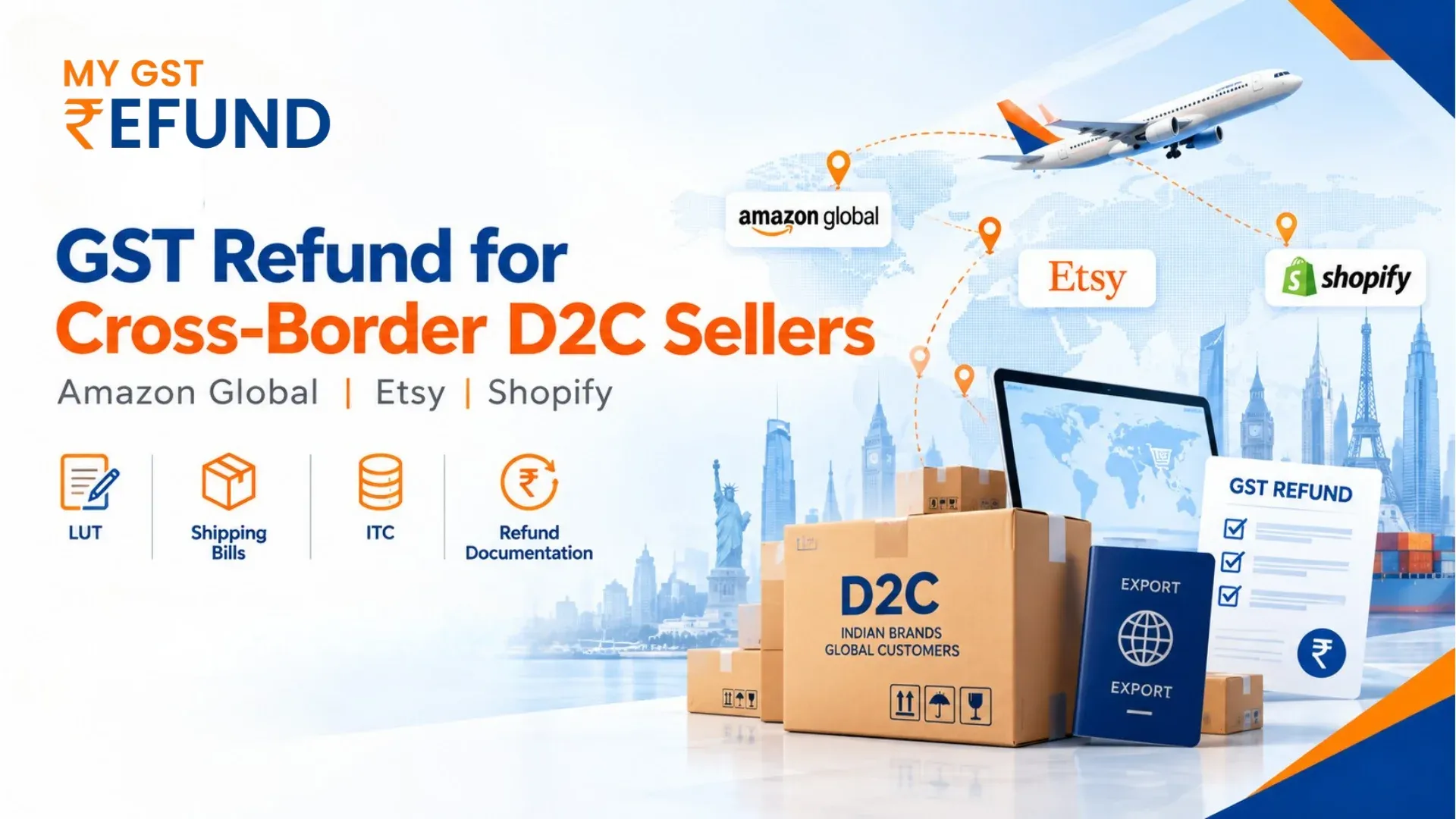
GST refund: Cross-border D2C exporters face a genuinely different documentation problem than a traditional exporter shipping container loads through a freight forwarder.
A D2C brand selling on Amazon Global, Etsy, and its own Shopify store simultaneously is really running three separate export documentation trails at once, and each platform hands off customs paperwork differently.
Get the shipping bill type wrong on even one channel, and that channel's ITC refund becomes unclaimable, not just delayed.
Is GST Applicable on International E-commerce Sales?
Selling from India to a buyer abroad, through any channel, is a zero-rated supply under Section 16 of the IGST Act, 2017, exactly like a traditional export.
No GST is meant to apply as a cost, whether the sale happens through a marketplace, your own website, or a courier-shipped parcel.
Zero-Rated Supply in E-commerce Exports: Two Routes, Same as Any Export
GST LUT Filing for Cross-Border E-commerce: What's Different Here?
D2C sellers file Form GST RFD-11 exactly like any exporter, valid per financial year.
The complication isn't the LUT itself; it's that the LUT ARN needs to correctly flow onto every shipping document, and with three different channels generating
shipment paperwork independently, that consistency breaks down easily.
Amazon Global Selling GST Refund: How the Documentation Actually Works?
Depending on the fulfilment and export arrangement, shipping documentation may be generated or handled by Amazon, its logistics partners, or the seller. Sellers should
verify how export documentation is generated for their specific fulfilment model

How to Claim GST Refund on Amazon Global Exports?
- Confirm whether your specific shipment used Amazon's proxy shipping bill or required you to generate your own; this depends on the fulfilment method and order value
- Match the merchant token and order ID from Amazon's seller reports against the shipping bill number for reconciliation
- Where Amazon files on your behalf, the shipping bill still needs to reference your GSTIN and LUT ARN correctly for the refund to trace back to your account
Amazon Proxy Shipping Bill GST Refund: The Reconciliation Point
Since Amazon consolidates and files shipping documentation at scale, sellers need to download and retain shipment-level reports from Seller Central regularly; this is the only reliable way to build the invoice-to-shipping-bill mapping your RFD-01 filing needs later.
Etsy Exports GST India: A Completely Different Setup
For Etsy orders, the seller should confirm the applicable export and courier documentation with the logistics provider handling the shipment and ensure that the required GST and customs details are correctly reported.
Step-by-Step Guide for GST Refund on Etsy Exports
- Confirm the shipment value and choose the correct courier shipping bill type (covered below)
- File the shipping bill/CSB yourself or through your logistics/courier partner, quoting your GSTIN and LUT ARN
- Retain the Etsy order confirmation and payment settlement report as supporting evidence
- Reconcile Etsy's payout report against the shipping bill and invoice for each order
Etsy PayPal FIRC for GST Refund India
Etsy payments typically settle through PayPal or Etsy Payments, which route to your Indian bank account as foreign inward remittance.
Payment settlement records and other applicable banking documents may be used to support reconciliation of export proceeds. The documentation required depends on whether the transaction is an export of goods or services and the applicable refund route, but since PayPal often batches multiple orders into one settlement, matching a single FIRC to individual invoices requires careful reconciliation, not a one-to-one assumption.
Shopify India International Shipping GST Refund: Your Own Website's Export Trail
Selling through your own Shopify or WooCommerce storefront means you are entirely responsible for every part of the export documentation chain; there's no marketplace filing anything on your behalf.
Payment Gateway FIRC for Shopify India Exports
International payment gateways (Stripe, PayPal, Razorpay's cross-border options) generate settlement reports that your bank uses to issue FIRC.
As with Etsy, pooled settlements covering multiple orders are common, making invoice-level reconciliation a genuine, recurring task rather than a one-time setup.
Courier Shipping Bill for GST Refund: CSB-IV vs CSB-V
This is the single most consequential decision in this entire process, and one most D2C sellers get wrong at least once.
Difference Between LUT and IGST Route for D2C Sellers
Regardless of CSB type, the LUT-vs-IGST choice governs whether tax is charged upfront, but CSB-IV shipments generally cannot be used to support an IGST refund claim at all, since the simplified declaration doesn't carry the formal customs data a refund officer needs to verify.
If a GST refund is being claimed for courier exports, exporters should ensure that the applicable courier export documentation, GSTIN details, customs filing, and other required declarations are correctly completed and transmitted for refund processing.
Why Is My E-commerce GST Refund Stuck? The Real Reasons
- Shipments filed under CSB-IV when the seller actually wanted to claim an IGST refund later; Using an incorrect or inappropriate courier export declaration can affect the availability or processing of a GST refund. Exporters should confirm the applicable declaration and refund requirements before shipping.
- LUT ARN not properly reflected on shipping documentation generated by a marketplace or courier partner
- Pooled payment settlements (PayPal, Stripe) not reconciled invoice-by-invoice, leaving FIRC unmatched to specific orders
- AD Code not linked at the specific port/courier hub the shipment moves through
How to Link AD Code for E-commerce Exports?
Exporters should ensure that their valid AD Code is appropriately registered with the relevant customs location or courier export facility, as applicable to their export process.
This is done through ICEGATE registration, and a shipment can get stuck if the AD Code isn't linked at that specific location, even if it's correctly linked elsewhere.
Input Tax Credit for E-commerce Sellers: What's Actually Claimable
For international D2C brands, claiming the right Input Tax Credit is key to maintaining healthy profit margins on zero-rated export supplies.
Knowing exactly which input service and goods costs are eligible helps you optimize your GST filings and streamline your refund process.
How to Claim ITC on Facebook Ads for Exports?
GST charged on eligible business advertising services may be available as ITC, subject to the applicable GST provisions, valid tax documentation, and the normal conditions for claiming ITC.
Marketplace Commission ITC
GST charged on eligible marketplace or platform fees may be available as ITC, subject to the supplier's tax invoice, the nature of the service, and applicable ITC conditions.
Can I Get a GST Refund on Export Packaging Material?
Yes, GST paid on eligible packaging materials used in the course of business may form part of eligible ITC, subject to the applicable ITC conditions and the requirements of the relevant refund formula
Can I Claim GST Refund on Courier Charges for Export?
Courier/freight charges paid to DHL, FedEx, or similar for the export shipment itself carry GST, and this ITC is claimable as part of the overall refund calculation, again subject to proper invoicing.
Merchant Exporter GST Refund Process: Where It Differs?
A merchant exporter (someone exporting goods manufactured by someone else, without manufacturing them themselves) can procure inputs at a concessional 0.1% GST rate under Notification No. 40/2017-Central Tax (Rate), subject to specific conditions, a route more relevant to D2C brands sourcing finished goods from third-party manufacturers rather than manufacturing in-house.
Documents Required for E-commerce Export GST Refund
- GSTR-1 and GSTR-3B for the claim period
- LUT copy (Form RFD-11), valid for the relevant financial year
- CSB-V (not CSB-IV) shipping documentation, invoice-wise
- Where payment settlements are pooled, exporters should maintain appropriate reconciliation between orders, invoices, settlement records, and applicable export documentation.
- Marketplace/platform commission invoices for ITC claims
- IEC and AD Code registration proof
Do I Need IEC for Selling on Etsy From India?
Yes, an Import Export Code (IEC) from DGFT is mandatory for any commercial export from India, regardless of the platform, and is a prerequisite for filing CSB-V shipments that support GST refund claims.
A Real Business Scenario
A D2C skincare brand sold through Amazon Global, Etsy, and its own Shopify store simultaneously. Amazon's proxy shipping bills were correctly filed, but their Etsy and Shopify shipments were routed through CSB-IV by their courier partner by default, since it was faster and cheaper per shipment.
When they later tried to claim an IGST refund on those channels, the claim was rejected outright. CSB-IV shipments simply don't carry the data needed to support a refund.
Switching to CSB-V for those channels going forward, despite the slightly higher per-shipment cost, was the only way to keep future refund eligibility intact.
Common Mistakes Cross-Border D2C Sellers Make
- Letting couriers default to CSB-IV without confirming whether GST refund eligibility matters for that channel
- Treating pooled PayPal/Stripe settlements as automatically matched to invoices without manual reconciliation
- Not retrieving GST-compliant fee invoices from marketplaces, losing claimable ITC on commissions
- Forgetting AD Code linkage at a new port or courier hub when scaling shipping volume
- Assuming Amazon's proxy filing covers every shipment type, including ones fulfilled outside FBA
GST Rules for Cross-Border D2C Websites: Quick Checklist
- LUT filed and current for the financial year
- AD Code linked at every port/courier hub in use
- CSB-V used wherever GST refund eligibility matters
- FIRC/FIRA reconciled invoice-by-invoice, not assumed from settlement totals
- Marketplace commission invoices retrieved and included in ITC claims
How Long Does It Take to Get a GST Refund for D2C Brands?
Following standard timelines: 90% provisional refund within 7 days of ARN generation under Section 54(6), with the remaining balance following standard scrutiny, typically within 60 days for a complete, well-reconciled application.
Latest Updates for Cross-Border D2C Sellers (2026)
- Budget 2026 removed the earlier value cap that restricted courier-mode commercial exports, easing volume-based shipping for growing D2C brands
- Section 54(14) amendment removed the minimum refund threshold, meaning small D2C brands can now claim even modest GST refunds on shipping and packaging costs that previously fell below the filing threshold
- Section 54(6) amendment extended 90% provisional refunds to inverted duty structure claims as well, relevant for D2C brands manufacturing products with higher-taxed inputs
Conclusion
For cross-border D2C sellers, the real GST refund challenge isn't the law; it's that Amazon, Etsy, and your own website each hand off customs and payment documentation differently, and one wrong shipping bill type quietly closes off refund eligibility for that entire channel.
Getting CSB-V, AD Code linkage, and FIRC reconciliation right per channel, from day one, is what keeps the refund door open as you scale.
Frequently Asked Questions (FAQs)
1. Can a D2C seller switch from CSB-IV to CSB-V for future shipments without any penalty?
Yes, there's no penalty for switching. CSB-IV vs CSB-V is chosen per shipment based on value and whether refund eligibility is needed, so future shipments can simply be filed under CSB-V going forward.
2. Does selling through multiple marketplaces require separate LUTs for each platform?
No, LUT is filed once per financial year at the GSTIN level and covers all export sales regardless of which platform or website the sale originates from.
3. Can a D2C brand claim GST refund on samples sent internationally for marketing purposes?
Generally no, since promotional samples sent without consideration don't qualify as a taxable export supply, and any ITC on inputs used for such samples typically isn't eligible for the export refund route.
4. Is there a different GST treatment for digital products (like downloadable designs) sold internationally via Etsy?
Yes, digital products sold to overseas buyers are treated as export of services rather than export of goods, following a different documentation trail (FIRC-based, no shipping bill) but still qualifying as a zero-rated supply.
5. What happens if a courier company loses or damages a shipment after the shipping bill is filed but before delivery?
The GST refund claim isn't automatically affected since the export itself (goods leaving India) is what matters for zero-rating, but the business would separately need to handle the commercial loss with the courier and possibly issue a credit note depending on the buyer arrangement.
Related Posts