TRACE Scheme: MSME Export Certification Subsidy
Published on: Tue Oct 27 2026
Adv. Hetal Bansal

Bio (Reveal/Hide)
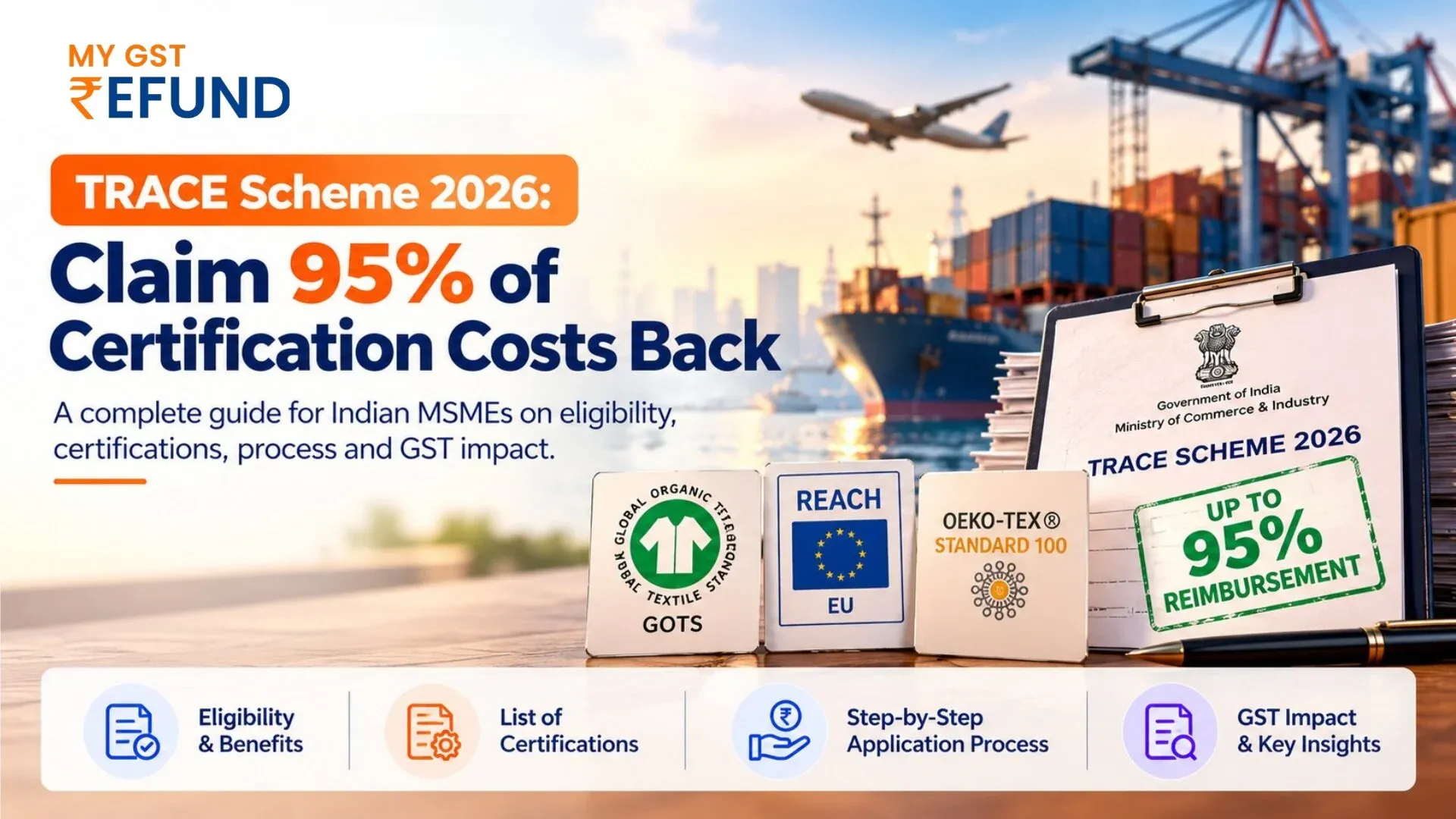
TRACE Scheme 2026: Claim 95% of Certification Costs Back
Why should a ₹3 lakh GOTS audit or a ₹10 lakh EU REACH registration decide whether an Indian MSME wins a European order? The government now pays back up to 95% of that cost under the TRACE Scheme 2026, so it doesn't have to.
Dealing with compliance costs is tough for MSMEs. They end up paying for things like test reports, audits, and various certificates way before they see any export money. Overseas buyers and regulators demand all this paperwork upfront, so your first container can’t even leave until you’ve spent a bunch.
TRACE steps in to help, but it’s only useful if you follow the right process and have your documents in order. This guide explains both.
What the DGFT Trace Scheme is and Where it Comes From?
Before calculating a claim, it helps to know which notifications govern it, because two of them changed the numbers within five months.
The Legal Framework
Full name: Trade Regulations Accreditation and Compliance Enablement (TRACE).
- Parent scheme: Niryat Disha, the non-financial arm of the Export Promotion Mission (EPM), approved by the Cabinet with an outlay of ₹25,060 crore for FY 2025-26 to FY 2030-31.
- Launch: Trade Notice No. 26/2025-26 dated 20 February 2026.
- Amendment: DGFT Trade Notice 09/2026-27 dated 1 July 2026.
- Official text: the DGFT TRACE scheme page and the TRACE operational guidelines.
Latest Updates (2026): What Changed on 1 July
The rate is now based on your Udyam category, instead of the list the certificate is in. That single shift makes enterprise classification the first thing to verify.
Who Qualifies for this MSME Export Incentive 2026?
With the numbers in place, the next question is whether your business can claim them at all.
Eligibility Checklist
What is Excluded?
- Supplies to SEZ units and deemed exports.
- Taxes, duties, and cess on the invoice.
- Any cost already claimed under another government scheme (a self-declaration is required).
Which Certifications Qualify: GOTS, OEKO-TEX, REACH and 459 More?
Eligibility is one thing; the certificate itself is another, and only listed entries may be used as a subsidy for TRACE.
Textiles and Chemicals
- Entry 115: All Organic Textiles (GOTS certification subsidy India).
- Entry 269: ECO-PASSPORT for textile and leather chemicals; Entry 353: OEKO-TEX Standard 100, which is reimbursed by the DGFT.
- EU REACH funding for MSME: Entry 352 Chemicals, textiles, consumer goods.
Other High-Demand Entries
Expert note: A listed name cannot be interpreted as an approval. For RC-1, the justification for the requirement should be presented such that established proof of required Ness or marketability exists, keeping the specification of the buyer or the importing country's regulation on file.
How is the Export Certification Reimbursement Calculated?
When the certificate qualifies, the amount is subject to a simple rule: The percentage is applied to the tax-exclusive amount or to the notified ceiling, whichever is the lesser.
Calculation Example
Both figures remain subject to any notified ceiling and the ₹50 lakh annual cap across all claims under that IEC.
How to Apply for TRACE Scheme DGFT: Step-by-Step
The total amount is helpful, but the order of application determines who gets it and who doesn't.
The Workflow
- File the Intent-to-Claim (IC) on the DGFT trade portal before you begin testing or pay the certifier.
- Finish the certification & receive the certificate or Test Report.
- File RC-1, tagging the IC, to release the first 50%.
- Ship the certified goods and realise the proceeds.
- File RC-2 with linked export evidence to release the balance.
Documents Required
Deadlines You Cannot Miss
RC-1: within 2 years of the IC, or the claim lapses and you lose eligibility for the next financial year.
RC-2: export evidence within 2 years of the first instalment, or the second instalment lapses and the first may be recovered.
The GST Angle Most TRACE Guides Ignore
Here is where a customs and GST lens adds money that the scheme guidelines never mention. TRACE reimburses only the tax-exclusive value, so the GST is entirely your cost unless you recover it.
Why the GST Still Matters?
- Domestic certifiers charge GST at 18% on testing and inspection services; this is eligible input tax credit.
- Foreign certifiers and EU Only Representatives supply an import of service, so you pay IGST under reverse charge under Section 5(3) of the IGST Act read with Notification 10/2017-Integrated Tax (Rate). Our guide on reverse charge versus forward charge explains the mechanics.
- Exporters under LUT often accumulate that credit. You can claim TRACE under Section 54(3) of the CGST Act, 2017, and also under Section 16(3) of the IGST Act, 2017, and Rule 89(4). The claim needs to go through Form RFD-01, and you’ve got two years from the relevant date to get it done. See the CBIC GST portal for the governing rules.
Real Client Scenario
A typical case we see: a knitwear exporter secures GOTS and OEKO-TEX, claims TRACE correctly, yet leaves the ₹57,600 GST locked in the electronic credit ledger for eighteen months.
Sector-specific steps for such units are covered in our GST refund guide for textile exporters.
Common Mistakes that Cost Exporters their Second Instalment
Even well-documented claims fail on avoidable errors, and most surface only at RC-2.
- Starting certification before filing the IC. The order is not a formality.
- Claiming the full invoice amount (including GST). It triggers a query and delays release.
- Generic shipping bill descriptions that fail to link exports to the certified product.
- Treating RC-1 money as final when non-export can lead to recovery.
- Ignoring the IEC-wide cap when several units or certificates claim together.
Conclusion
The TRACE Scheme 2026 is now more like an investment, rather than being a compliance burden, assuming you file an IC first, attach every export to the certificate, and keep track of both 2-year timelines. The scheme includes the fee, but the GST on that is a separate recovery which exporters generally leave unclaimed.
That second recovery is where MYGST Refund helps. Its automated platform reconciles your export ITC, prepares RFD-01, and tracks the refund to credit. Estimate your recoverable amount with the GST refund calculator or book a free demo with the team today.
Frequently Asked Questions (FAQ's)
1. What is the TRACE Scheme 2026?
It’s part of the Niryat Disha reimbursement schemes. If you qualify, you can get up to 95% of your eligible test and inspection certification costs back if you’re a micro or small business; medium-sized businesses get up to 80%.
2. What is the maximum reimbursement per year?
₹50 lakh per IEC per financial year. Amounts above that are considered case by case by the Sub-Committee.
3. Is GOTS or OEKO-TEX covered?
Yes. GOTS is entry 115, while the OEKO-TEX Standard 100 is entry 353 in Annexure I of DGFT Trade Notice 09/2026-27
4. Can I apply after obtaining the certificate?
No. The Intent-to-Claim must be filed before the certification process starts.
5. Is the GST on certification fees reimbursed?
No. TRACE pays only the tax-exclusive cost, but that GST is usually recoverable as input tax credit and, for LUT exporters, through a refund under Section 54(3).
Related Posts