Export of Services in INR: CBIC Circular 263 Explained
Published on: Thu Nov 26 2026
Adv. Hetal Bansal

Bio (Reveal/Hide)
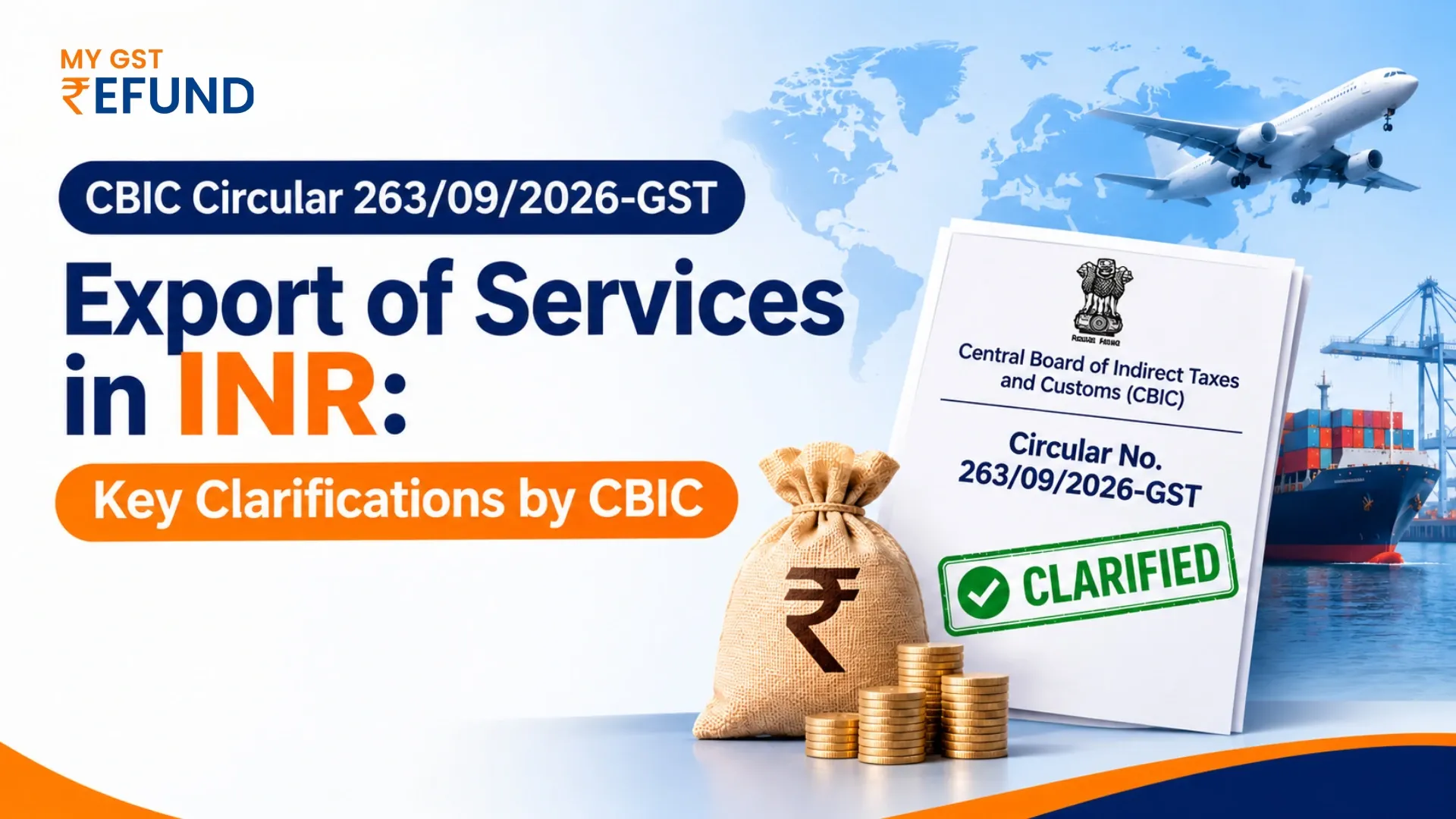
Export of Services Payment in INR: Circular 263 Explained
Does an export of services payment in INR cost you zero-rating if it reaches a rupee account instead of arriving in dollars? For years, many refund officers said yes, stalling legitimate claims over the bank channel rather than the service.
Circular 263/09/2026-GST, issued by CBIC on 26 October 2026, ends most of that confusion. It lists the payment routes that satisfy the export test and eases Rule 96B recoveries for goods. Here is what changed, what did not, and how to build a refund file that survives scrutiny.
Why Payment Mode Decides Whether a Service Is an Export
A service is an export only if all five conditions in Section 2(6) of the IGST Act are met, and the payment condition caused the most trouble.
The Problem, the Cause and the Fix
- Problem: Refunds rejected because consideration arrived in Indian rupees.
- Cause: A literal reading of Section 2(6)(iv) of the IGST Act, which requires payment "in convertible foreign exchange or in Indian rupees wherever permitted by the Reserve Bank of India." Officers often treated "wherever permitted" as covering almost nothing.
- Fix: Circular 263 builds on Circular 202/14/2023-GST, which had accepted Special Rupee Vostro receipts, and confirms that every repatriable rupee channel permitted under FEMA satisfies the condition.
Example: A Pune consultancy paid in INR through its UAE client's bank's Vostro account once drew a deficiency memo. That receipt now clearly meets condition (iv).
With the legal test settled, the next question is practical: which channels exactly qualify?
Get expert help to claim your eligible export GST refund with hassle-free documentation, filing, and application support.
Accepted Payment Channels Under Circular 263
Read with the FEMA (Manner of Receipt and Payment) Regulations 2023, the circular accepts these routes, each with its own evidence trail.
The NRO line matters most to one industry in particular.
Stockbrokers Serving FPIs, NRIs and OCIs
Brokers paid in rupees by overseas investors are addressed by name.
- SNRR and NRE receipts: These may satisfy condition (iv).
- NRO receipts: These must be routed through SNRR or NRE accounts to qualify. A direct debit from an NRO account does not meet the test.
A stockbroker payment from an NRO account therefore qualifies only through a repatriable route, and place of supply must still be met separately.
Netting, the next topic, changed significantly this year.
Set-off of Export Receivables Against Import Payables After 1 October 2026
Exporters who buy from and sell to the same overseas group often net balances, which once put export status at risk.
What the FEMA ₹Export and Import Regulations 2026 Changed?
Under the earlier RBI rules, set-off was limited to goods against goods and services against services. The circular records that, from 1 October 2026, the FEMA (Export and Import of Goods and Services) Regulations 2026 no longer carry those restrictions.
- A set-off of export receivables against import payables done under RBI directions satisfies condition (iv).
- Informal netting without AD bank reporting is not covered.
Caution: Confirm current RBI directions and your AD bank's procedure before netting. Reinsurance brokers face a similar netting question.
Reinsurance Brokers: Net Retention
Reinsurance brokers keep commission out of the premium they pass on, so no separate remittance arrives.
Clarification: FEMA treats the foreign reinsurer as having paid by authorising the broker to retain the commission.
Result: Reinsurance broker commission through net retention counts as receipt, since the realisation obligation is extinguished.
Evidence: Statements of gross premium, commission and net remittance.
For goods, the issue is timing rather than channel.
Export of Goods: Realisation Period and Rule 96B
Goods exported on payment of IGST get a refund before payment is realised. Rule 96B claws that refund back if proceeds never arrive.
So the realisation period for export proceeds under Rule 96B follows the amended Master Direction, not a fixed number.
Expert flag: Rule 96B's text refers to a write-off by the RBI. The circular extends relief to an AD bank write-off. That relaxation rests on the circular, not the rule, so keep the bank's write-off letter safe in case a field officer reads the rule strictly.
The refund file is the other half of the job.
Refund Documentation by Route
Officers judge zero-rating from documents, so match the file to the route.
Filing RFD-01 before collecting bank advices invites a deficiency memo. If you want a second pair of eyes before filing, the MYGSTRefund team helps exporters file refunds and reply to deficiency memos.
What Circular 263 Does Not Solve?
The circular clarifies one condition, and two problems remain.
Section 2(6)(v): Supplier and recipient still cannot be merely establishments of a distinct person. The 57th GST Council recommended omitting this clause on 8 October 2026, but the amendment is pending.
Intermediary disputes: Section 13(8)(b) was omitted by the Finance Act 2026, yet claims for earlier periods still face place-of-supply objections.
A worked scenario ties the pieces together.
Real Business Scenario: A SaaS Exporter
Consider a Bengaluru SaaS company exporting under LUT to a Singapore client for an illustrative ₹1.2 crore a year.
- Quarters 1 to 3: ₹90 lakh paid by the client from its SNRR account. The bank advises the account type, and e-BRCs are generated.
- Quarter 4: ₹30 lakh set off against cloud-hosting import payables to the client's group, under RBI directions, with AD bank reporting.
- File: Invoices, agreement, SNRR advices, e-BRCs, set-off approval and reconciliation.
- Outcome: Condition (iv) is met for all four quarters, so the Rule 89 refund rests on documents.
Most failures trace back to avoidable errors.
Common Mistakes to Avoid
- Accepting NRO payments directly instead of insisting on SNRR or NRE routing
- Setting off receivables without the bank's reporting
- Filing refunds without realisation proof
- Assuming Rule 96B recovery applies after a write-off
- Ignoring the distinct-person bar for group entities
Conclusion
Circular 263/09/2026-GST turns a vague phrase into a working list of rupee channels, set-offs and net retention, and AD bank write-offs now shield goods exporters from Rule 96B recovery.
Frequently Asked Questions (FAQs)
1. Is payment through an SNRR account valid for export of services under GST?
Yes. SNRR receipts satisfy Section 2(6)(iv). Keep bank advice naming the source account.
2. Can export receivables be set off against import payables for a GST refund?
Yes, if it follows RBI directions and is reported through your AD bank. Cross-category set-offs are no longer barred from 1 October 2026.
3. Is there no GST refund recovery if the AD bank writes off export proceeds?
Correct. The circular says no Rule 96B recovery applies after an AD bank write-off, wholly or partly. Preserve the write-off letter.
4. Does Circular 263 apply to branch services?
No. Section 2(6)(v) still bars supplies between establishments of a distinct person until Parliament amends the law.
5. Does the circular apply to pending refund claims?
The circular does not state an effective date, but as a clarification of existing law, it is widely cited in pending matters.
Related Posts