rcm-e-invoicing
Published on: Thu Oct 22 2026
Adv. Hetal Bansal

Bio (Reveal/Hide)
E-Invoicing for RCM 2026: RCMDOM and RCMIMP Self-Invoice Guide
Your ERP already pushes every sales invoice to the IRP, so why does your reverse charge register still live in a spreadsheet? Until now, e-Invoicing for RCM stopped at invoices from registered suppliers, and the self-invoices you raise as a recipient never reached the Invoice Registration Portal. That blind spot is why finance teams find missing self-invoices only when an auditor asks, or when ITC hits the Section 16(4) deadline.
GSTN has now started closing that gap. Let's look at what changed, who it applies to, and how to prepare yourself ahead of the production date.
What GST Advisory 678 Changes for Reverse Charge e-Invoicing?
GSTN issued Advisory No. 678 on the GST portal on 16 October 2026, based on the recommendation of the 57th GST Council meeting on 8th October 2026.
The Two New Supply Types
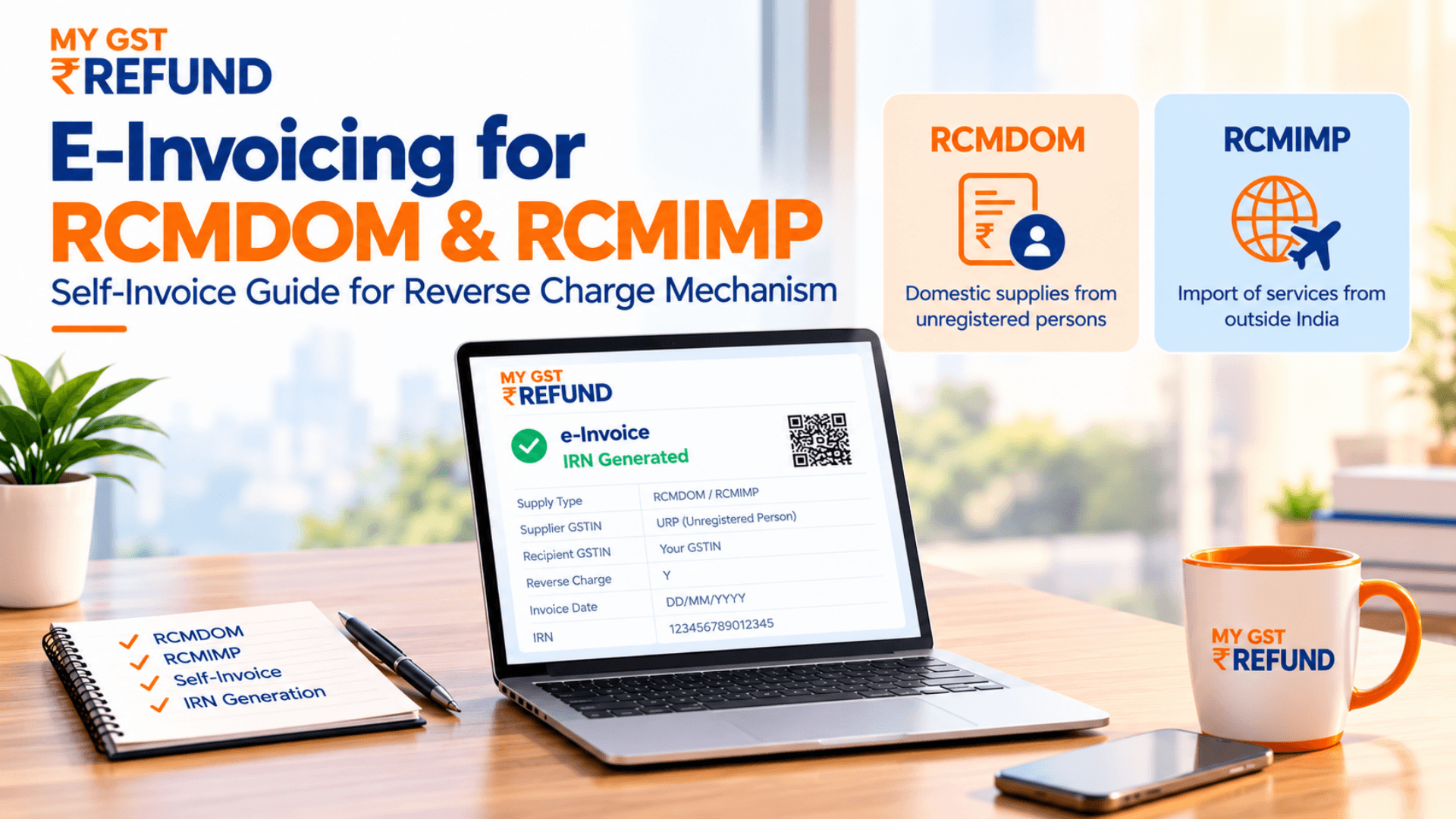
Previously, IRPs accepted only supplier-provided documents. Under the new facility, the recipient selects RCMDOM or RCMIMP, reports the self-invoice to an authorised IRP, and receives an IRN once validations pass. That raises an obvious question: why does a buyer issue an invoice at all?
The Legal Backbone: Why Recipients Issue Self Invoices?
The self-invoice isn't new, but its reporting is. That obligation is as of 2017, and the changes in 2024 made it much more significant.
Provisions That Create the Obligation
Why the Government Wants an IRN Here?
A foreign or unregistered supplier files no GSTR-1, so the department has nothing to match against your RCM payment in GSTR-3B Table 3.1(d). An IRN fills that gap. With the "why" clear, the next question is "who".
Who Is Eligible for RCM e-Invoicing?
The existing e-invoice 5 crore threshold carries over.
Expected Coverage
Is RCM Self-Invoicing Mandatory on IRP Yet?
No. Today, under clause (3)(f) of section 31 of the IRP, there was no obligation for IRP reporting, but there was for self-invoicing. GSTN has stated that the date for production and reporting rules will come subsequently through the notification and to consider the sandbox as a rehearsal. With scope settled, the practical work moves into your systems.
How will the IRP validate RCMDOM and RCMIMP?
Standard e-invoice logic assumes a registered supplier, so these supply types need different validations. Per NIC IRP-1, the validations and error codes will be uniform across all six IRPs (NIC IRP-1 and IRP-2, Cygnet, Clear, EY, and IRIS).
Key Validation Points
- Supplier GSTIN: Reported as "URP" (unregistered person).
- IRN hash: Built using the recipient's GSTIN, since the recipient is the issuer.
- Reverse charge flag: Set to "Y".
- RCMIMP only: Limited to services; the supplier country must be outside India, and no e-way bill can be generated.
How to Generate IRN for a Self Invoice?
- Raise the self-invoice within 30 days of receipt.
- Tag it RCMDOM or RCMIMP, with "URP" as the supplier GSTIN.
- Push the JSON to your IRP via API or GSP.
- Store the IRN and signed QR code against the purchase entry.
Two common cases show how this works with real numbers.
Worked Examples: RCMDOM and RCMIMP in Practice
RCMIMP: Software Subscription from the USA
A Pune IT exporter (AATO Rs 40 crore) pays USD 10,000 to a US cloud provider.
Since the exporter's outputs are zero-rated, this credit often accumulates. An IRN-backed self-invoice makes it easier to support a refund claim, where MyGSTRefund helps exporters track eligible amounts.
My GST Refund helps exporters with refund eligibility, documentation, application filing, and follow-ups to simplify the GST export refund process.
RCMDOM: Cement Bought by a Real Estate Promoter
A promoter buys cement worth Rs 5,00,000 from an unregistered dealer under Notification 07/2019-CT(Rate). CGST and SGST of Rs 45,000 each (18%) are paid under RCM, and the self-invoice is reported as RCMDOM.
On paper, this looks simple, yet the same errors repeat in practice.
Common Mistakes We See in RCM Self-Invoicing
In our experience reviewing RCM ledgers, most problems start before the IRP stage.
One services exporter we advised had a year of foreign SaaS bills but no self-invoices, which made its refund claim hard to defend. Clean data now will also make the IRP rollout painless.
ERP Update for RCM e-Invoicing: Your Readiness Checklist
To support pre-go-live testing, GSTN has opened the sandbox early, enabling vendors and taxpayers to test in the sandbox environment.
Step-by-Step Preparation
- List 12 months of RCM purchases from unregistered persons and imports of services.
- Confirm AATO against Rs 5 crore.
- Ask your ERP vendor, GSP, or ASP for RCMDOM and RCMIMP support.
- Test on the NIC e-Invoice API sandbox or any IRP sandbox.
- Test errors for URP, country code, and reverse charge flag.
- Reconcile IRNs with GSTR-3B Tables 3.1(d) and 4A(3).
- Track the official e-invoice portal.
Finally, keep an eye on the dates, as the rollout is still moving.
Conclusion
There's no change in the identity of taxpayers or the amount of tax due for e-Invoicing (RCM). It will help you know what you lose due to reversed charge, ensure that the reversed charges are documented, and make it easy to detect late or missed self-invoices. Businesses that clean up RCM registers and test now will move into production smoothly.
If your business imports services or exports with accumulated ITC, MyGSTRefund can help you link IRN-backed self-invoices to faster, well-documented GST refund claims. Talk to our team to review your RCM and refund position before the mandate goes live.
Frequently Asked Questions(FAQ's)
1. Is RCM self-invoicing mandatory on the IRP from October 2026?
No. Both are only in the sandbox until the effective date is notified.
2. Who is eligible for RCM e-invoicing?
Registered taxpayers with an AATO of Rs 5 crore or more are expected to be covered, subject to the final notification.
3. What is the time limit to issue a self-invoice under Section 31(3)(f)?
Rule 47A allows 30 days from receipt of the supply.
4. Does an RCMIMP e-invoice generate an e-way bill?
No. RCMIMP covers only services, so no e-way bill applies.
5. Does e-invoicing change my RCM tax liability or ITC?
No. Liability and ITC under Section 16 stay the same; only reporting changes.
Related Posts