GST REG-16 Revised Process: New GST Cancellation Rules
Published on: Wed Nov 25 2026
Adv. Hetal Bansal

Bio (Reveal/Hide)
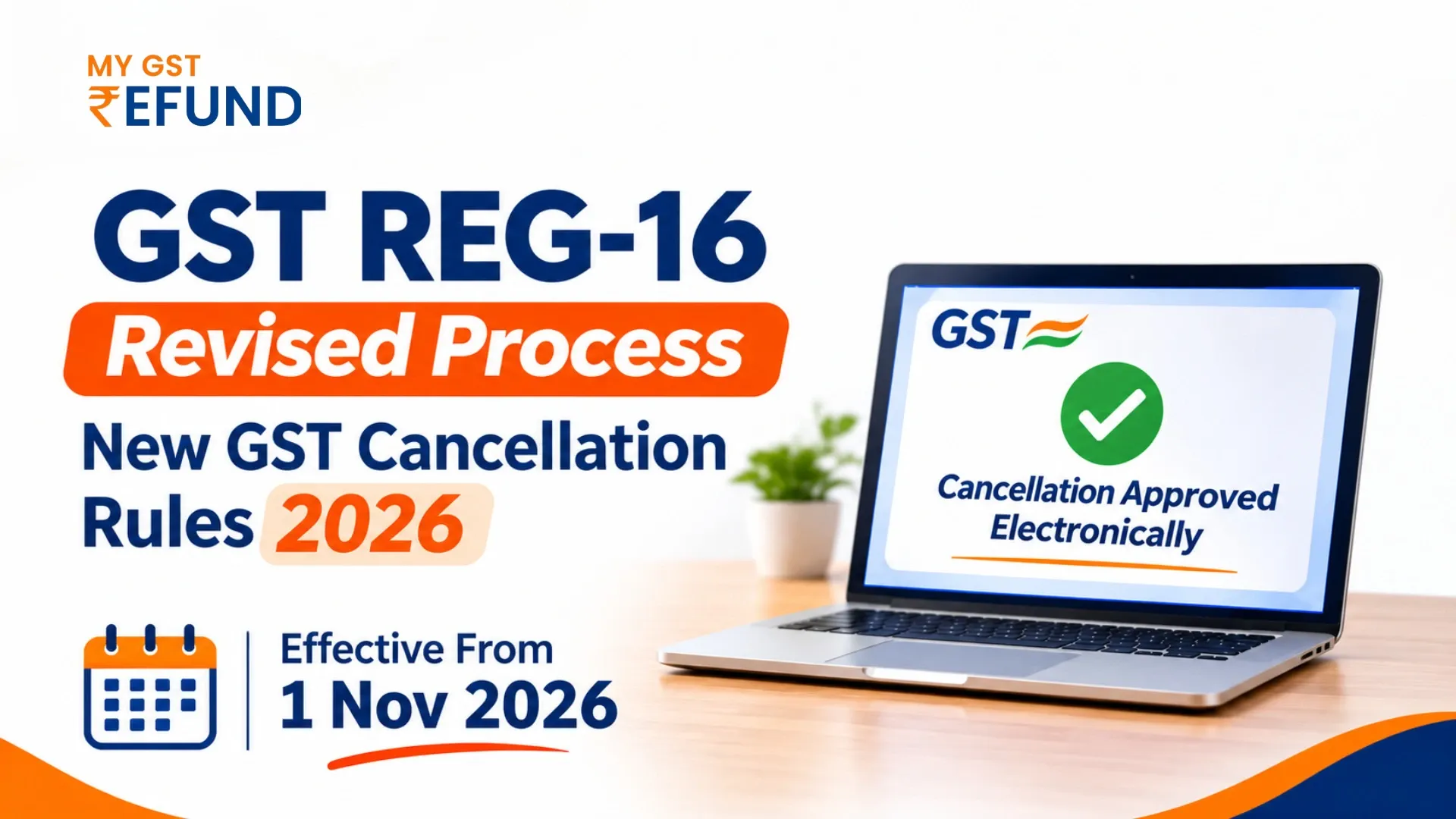
GST REG-16 Revised Process: Get Cancellation Auto-Approved
Why do some GST cancellation applications now close within days, while others still sit with an officer for weeks? The answer lies in the Form GST REG-16 revised process, explained in GSTN's advisory of 1 November 2026.
Under the earlier process, GST registration cancellation applications generally required examination and approval by the jurisdictional tax officer. Under the revised Rule 20, eligible applications can now receive electronic cancellation approval through a system-driven process without officer intervention, subject to prescribed conditions. However, one missed return or one high-value month can still push you back to manual processing, so this guide explains every filter and how to clear it.
What Changed in GST Registration Cancellation From 1 November 2026?
The legal basis is Notification No. 05/2026-Central Tax dated 26 October 2026, which substituted Rule 20 of the CGST Rules from 1 November 2026. It implements Phase 1 of the reforms recommended at the 57th GST Council meeting.
Key Provisions of the Rule 20 CGST Rules Amendment
The substituted rule changes both the pre-filing conditions and the approval route.
With the legal basis clear, let's look at the first check the portal runs.
Return Filing Prerequisites Before Submitting REG-16
The portal now blocks submission of REG-16 until your filing history is complete. This is the most common point of failure.
Returns the Portal Verifies
The system checks every return due on or before the effective date of cancellation you enter.
- All due GSTR-1 or IFF and GSTR-3B returns
- CMP-08 statements for composition taxpayers
- GSTR-3B for every period where GSTR-1 or IFF was filed
Why GSTR-1 and GSTR-3B Matching Matters
Many businesses file GSTR-1 so buyers can claim credit, but delay GSTR-3B because of cash flow. The portal treats that gap as a pending return, so the form will not
submit until GSTR-3B is filed.
The Pending for Returns Filing Stage
If some returns up to the effective date are not yet due when you apply, the application moves to "Pending for Returns Filing." This is not a rejection. File those returns by their due dates; otherwise, the case goes to the jurisdictional officer.
Once returns are cleared, the portal sorts your application by taxpayer category.
Automatic Approval of Form GST REG-16 by Taxpayer Category
The GSTN advisory on GST cancellation approval treats taxpayers differently based on the risk they carry.
Composition, NRTP, OIDAR and ISD Taxpayers
Composition taxpayers, Non-Resident Taxable Persons (NRTPs), OIDAR taxpayers and Input Service Distributors (ISDs) are eligible for electronic cancellation without officer intervention, subject to fulfilment of the prescribed return-filing and payment conditions. The specific ₹2.5 lakh monthly B2B output tax liability threshold does not apply to these categories.
Regular, Casual and SEZ Taxpayers
These taxpayers face an extra test under Rule 20(5)(a). The portal checks output tax liability on supplies to registered persons, as declared in GSTR-1, GSTR-1A or IFF.
What the ₹2.5 Lakh Output Tax Liability Limit Really Means?
This is where most taxpayers misread the rule.
- It is not a turnover limit; it measures tax charged
- It combines CGST, SGST or UTGST, IGST, and compensation cess
Only B2B supplies count - It runs for every month from registration, not just recent periods
The threshold is calculated based on the output tax liability declared on B2B supplies in GSTR-1, GSTR-1A or IFF. It is not based on turnover or the total value of invoices issued. The calculation considers the applicable GST components, including CGST, SGST/UTGST, IGST, and compensation cess. For taxpayers above this limit, the next rule becomes critical.
Form GSTR-10 Filing Within 3 Days Under the New Rule
Taxpayers exceeding the ₹2.5 lakh monthly B2B output tax liability threshold can still qualify for electronic cancellation by filing Form GSTR-10 within the prescribed three-day period. The deadline is calculated from the due date of the pending returns identified in the "Pending for Returns Filing" stage or, where this stage does not apply, from the date of submission of Form GST REG-16.
When does the 3-Day Window Start?
The start date depends on whether your application entered the pending stage.
The application then moves to "Pending for Final Return." Timely GSTR-10 leads to electronic approval; otherwise, the officer takes over.
GSTR-10 After Officer Cancellation
Where an officer cancels the registration, the advisory gives 90 days from the effective date of cancellation to file GSTR-10. Section 45 frames this as three months from the cancellation date or order date, whichever is later, and late filing attracts a late fee.
If the electronic route fails, it helps to know how the officer route now works.
Timelines When the Application Goes to a Tax Officer
Rule 20(6) to (12) now sets fixed timelines for manual cases.
The officer issues REG-19 or a notice in REG-03 within 15 days
- You reply in REG-04 within 15 days
- The officer decides within 15 days of your reply, through REG-19 or REG-05
- No reply leads to deemed rejection, intimated in REG-05A
- Officer inaction leads to deemed approval
Practical Scenario and ITC Reversal Calculation
The following scenario reflects a pattern practitioners often see.
A Trader Closing Business in December 2026
A regular trader stops trading on 15 December 2026. In one month in 2024, the trader charged ₹3.1 lakh GST on B2B supplies, and December returns are not yet due.
- The application enters "Pending for Returns Filing"
- December returns are filed by their due dates
- GSTR-10 must follow within 3 days, because one month has crossed ₹2.5 lakh
ITC Reversal on Stock Under Section 29(5)
The trader must pay the higher of ITC on stock and capital goods or the output tax on their value.
Common Mistakes That Block Automatic Cancellation
Most referrals come from a few avoidable errors.
- Entering an effective date that conflicts with unfiled periods
- Filing GSTR-1 without GSTR-3B for the same month
- Leaving interest or late fees unpaid
- Missing the 30-day window from the closure event
- Ignoring pending refunds, since Rule 21A bars refunds during suspension
That last point catches many exporters. Tracking claims through a tool like the MYGSTRefund Platform helps you settle every refund before applying.
Latest Updates on GST Registration Cancellation 2026
The reform is being rolled out in stages.
Conclusion
The Form GST REG-16 revised process rewards clean compliance with fast, officer-free cancellation. File every return, test each month's B2B tax against ₹2.5 lakh, and keep GSTR-10 ready if you cross it.
Since registration is suspended the moment you apply, settle every refund first. If export or inverted duty refunds are still pending, MYGSTRefund can help you file, track, and close them before you exit GST.
Frequently Asked Questions (FAQ's)
1. Is GST registration cancellation now fully automatic?
Not yet. Phase 1 is approved electronically only when returns are filed, dues are paid, and the ₹2.5 lakh or 3-day GSTR-10 condition is met.
2. Does the ₹2.5 lakh limit apply to turnover?
No. It applies to monthly output tax on supplies to registered persons, as reported in GSTR-1, GSTR-1A or IFF.
3. Can I issue invoices after applying?
No. Registration is suspended from the application date, so taxable supplies should stop.
4. What if I miss the 3-day GSTR-10 window?
The application goes to the officer. It is not rejected, but approval takes longer.
5. When do the new REG-16 form fields apply?
From 1 December 2026, along with the related Rule 44 reporting changes.
Related Posts