RBI’s New Export Declaration Form (EDF) Rule
Published on: Thu Oct 08 2026
Adv. Hetal Bansal

Bio (Reveal/Hide)
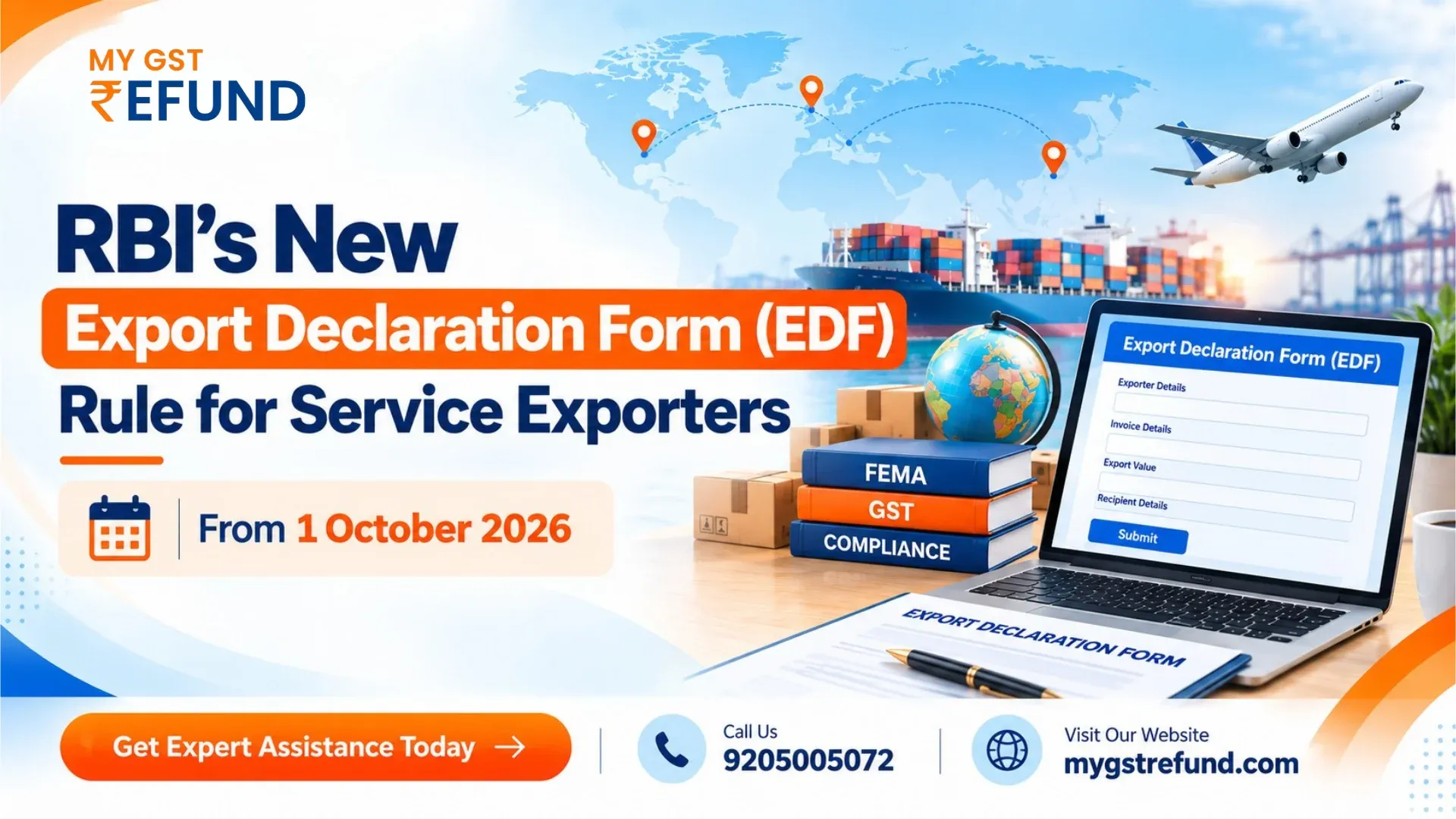
RBI’s New Export Declaration Form (EDF) Rule for Service Exporters from 1 October 2026
Has your bank suddenly asked for an EDF reference before releasing a foreign payment into your account? From 1 October 2026, the new FEMA framework extends export declaration requirements to covered exports of services and software. Exporters should determine whether their transactions fall within the applicable reporting requirements and follow the procedure prescribed by RBI and their Authorised Dealer (AD) bank.
The trouble is that this requirement arrived on top of the GST invoices, LUTs and FIRAs that exporters already manage. RBI's relief for individuals also came a full week after the rule went live. Most of the confusion comes from one gap: The applicable regulation does not specify a general invoice-value threshold for the service-export declaration requirement. However, RBI's recent clarification regarding individuals and personal-nature contracts should be considered separately, and exporters should check the latest RBI guidance before filing.
This guide closes that gap. It details who can fill it, how, when, what information to provide, and what your bank will do after you enter it to ensure foreign earnings remain clean on the FEMA side and on the GST side.
Want to claim your GST export refund? Connect with MyGST Refund Team for professional assistance with your export refund process.
What is an Export Declaration Form (EDF)?
It's important to understand what the form does before considering the question of deadlines. After you get the intent, all of the rules that follow begin to make sense.
EDF Full Form and Legal Basis
- EDF full form: Export Declaration Form.
- Legal source: Regulation 2(1)(c) of the FEMA (Export and Import of Goods and Services) Regulations, 2026, notified as FEMA 23(R)/2026-RB on 13 January 2026. The format itself is prescribed in the EDF Annex published by RBI.
- Core obligation: Regulation 3(2) sets out the declaration requirement for exports of services and specifies the manner in which the export value is to be declared to the relevant "specified authority”.
Having established the fundamentals, the next question is what changed on 1 October?
What Changed from 1 October 2026?
The new regime did not appear overnight. It was revised by several drafts in 2026, and the most recent rules are significantly different from those found in January articles that are widely cited.
Timeline of Latest Updates (2026)
What This Means in Practice?
- Covered service-export transactions are brought into the applicable export-monitoring framework, allowing the AD bank to track declaration and realisation of export proceeds.
- Software leaves SOFTEX. Software exports move into the same EDF framework (covered in Section 8).
- AD banks have an expanded role in handling export realisation, extensions, set-offs and other permitted transactions under the revised framework, subject to the applicable RBI conditions.
Who Needs to File an EDF Form for Services Exporters?
Regulation 3(2) applies to "an exporter of services" and sets no turnover or invoice threshold. Coverage therefore depends on the nature of the transaction, not on its
size.
Are Individuals Covered? Is EDF Mandatory for Freelancers?
RBI has clarified that individuals undertaking services under contracts of a personal nature are not required to report these transactions under the new framework.
Examples cited in the clarification include tutoring and small software work. The Governor gave tutoring and small software work as examples of individual services that need no reporting.
A GST expert would flag two caveats here:
- The regulation text has not changed. The exclusion currently rests on public statements, and "personal nature" has not been defined.
- A registered freelancer may look like a business. A GST-registered freelancer providing B2B services to an overseas client may require a transaction-specific assessment. Where the applicability of EDF is unclear, the exporter should obtain confirmation from the AD bank.
Until the FAQs arrive, freelancers in this middle zone should get written guidance from their bank. We will update this section once RBI publishes the FAQs, so check back.
Where to File an EDF?
The 2026 Regulations name a "specified authority" for each category of exporter in Regulation 2(1)(f).
Where the authority is not an AD bank, Regulation 3(3) requires it to forward the authenticated EDF to your AD bank. This means the bank always ends up holding the record.
When to File an EDF? The 30-Day Deadline
For transactions covered by the applicable monthly declaration mechanism, the EDF is to be submitted within the prescribed period calculated from the end of the relevant invoice month.
The new framework applies to relevant export transactions covered from 1 October 2026 onwards. Exporters should follow the transition provisions applicable to earlier transactions.
How to File EDF for Service Export: Step by Step
The exact interface varies from bank to bank. Exporters should check their AD bank's prescribed procedure, documentation requirements, and filing channel before submitting an EDF, as operational processes may differ between banks.
- Confirm the transaction qualifies as an export of services (see Section 3).
- Collect the month's export invoices and the related contracts.
Obtain the bank's EDF format from the trade portal or branch of the bank, as well as the AD code. - Complete the exporter and importer information and add each invoice to the service value line.
- Include any documents that your bank will require, typically bills and contracts.
- Make sure to submit early, before the 30-day deadline, and retain the acknowledgement.
- Verify the EDPMS: After submission, exporters should verify that the declaration has been appropriately recorded in EDPMS and follow up with the AD bank if the entry is not reflected within the bank's prescribed processing timeline.
- With accuracy at step 4 being the foundation for all subsequent steps, it is wise to take a closer look at what the form asks for.
What Details fill in the EDF?
The prescribed format has two parts: general export information and a dedicated section for the value of services.
Expert tips that prevent bank queries:
- Use the same invoice number and date that you report in GSTR-1 Table 6A.
- Use the same SAC code as on your GST invoice. A mismatch between the SAC code reported on the EDF and the GST invoice may result in clarification requests or delays in processing.
- Provide terms with the third party in the event the payer is not the beneficiary. For third parties, approval is required for receipts under Regulation 8.
Much of this applies to all exporters, but software companies must follow some additional rules.
EDF for Software Exporters: Transition from the SOFTEX Framework
Regulation 2(1)(e) defines software broadly: any program, database, design or audio-visual signal delivered on a non-physical medium. The Regulations also state expressly that "services" include software.
SOFTEX-related transactions and pending cases should be dealt with according to the applicable transitional provisions under the revised FEMA framework. Exporters with legacy pending cases should confirm the treatment with their AD bank or the relevant authority. Regulation 20 also lets AD banks clear legacy cases that once required RBI approval.
Whether your exports are software or other services, filing is only half the cycle. The other half begins once the money arrives.
What Happens After You File an EDF?
Competitor guides repeatedly overlook this, but it is where most open entries tend to become trapped.
EDPMS EDF Payment Matching
- When export proceeds are received, the AD bank records the relevant inward remittance information and undertakes the applicable matching and realisation process in EDPMS.
- The bank then matches that IRM against your EDF entry.
- Each receipt must have the proper purpose code, as the wrong code will affect the match.
How to Close the EDF Entry in EDPMS?
Exporters generally need to coordinate with their AD bank for verification and closure of the corresponding EDPMS entry after realisation. Under Regulation 18(1)(g), your bank marks it off after confirming realisation, so always ask for written confirmation of closure.
Invoices up to ₹10 Lakh: Self-Declaration of Receipt
For eligible export transactions within the prescribed value limit, the regulations provide a mechanism for the AD bank to accept a self-declaration of receipt,
subject to the applicable conditions.
You can also file these declarations quarterly to close entries in bulk. For higher-value invoices, FIRA documents help the bank create the IRM and complete the match.
eBRC Generation After EDF Filing
Once the bank matches the payment, it reports the realisation and an eBRC is generated on the DGFT platform. For export-of-services refund claims, supporting evidence of realisation such as BRC/FIRC, as applicable under the GST refund framework, may be required. Exporters should ensure that their foreign-remittance records and invoices
and GST records are properly reconciled.
Mismatches between invoices, foreign-remittance records and GST documentation can also create challenges during export refund processing. MYGST Refund helps exporters reconcile these records and manage their GST refund process.
Bank Charges
Some banks charge fees for regularising remittances or issuing eBRCs. Banks may levy applicable charges for export-related processing and documentation. Exporters should check their AD bank's current schedule of charges before submitting an EDF.
Realisation Period: 9 Months (12 for INR)
Common EDF Mistakes
Even careful exporters slip up in the first few cycles. These are common errors that may result in processing GST Refund delays, clarification requests, or open EDPMS entries.
A typical scenario: an agency invoices through a payment gateway, but the gateway settles into a bank other than the one where the EDF was filed.
If the payment is received through a different bank or the remittance details do not correspond with the EDF, the exporter may face difficulties in matching the receipt and closing the EDPMS entry, which can also delay related documentation such as the eBRC.
Monthly EDF Checklist
Conclusion
An Export Declaration Form is an important part of the revised export-reporting framework. For service exporters, maintaining consistency between invoices, EDF records, foreign-remittance documentation, EDPMS records, and GST filings can help reduce compliance issues and delays in the refund process. If you have all of these correct, it becomes much easier to follow the next steps.
Frequently Asked Questions (FAQ's)
1. Is EDF mandatory for freelancers?
RBI said on 7 October 2026 that individuals with contracts of a personal nature, such as tutoring, do not need to report. GST-registered freelancers billing businesses should confirm their position with their bank until the FAQs are released.
2. Has SOFTEX been discontinued and replaced by EDF?
Yes, for invoices from 1 October 2026. Software exporters now file an EDF with their AD bank or STPI, or with the SEZ Development Commissioner if they operate from an SEZ.
3. Can I file one EDF for all my clients?
Yes. Regulation 3(2)(a) permits a single consolidated EDF covering all recipients in a month.
4. Is EDF a GST return?
No. It is a FEMA declaration. GST export compliance, including your LUT and refund claims, continues separately.
5. What happens if export proceeds are not realised in time?
Your AD bank can grant an extension. If proceeds stay unrealised for more than a year past the due date, Regulation 13 restricts you to future exports against full advance payment or a letter of credit.
Related Posts