GST Refund Stuck? Common Reasons & Solutions
Published on: Mon Jun 29 2026
Adv. Hetal Bansal

Bio (Reveal/Hide)
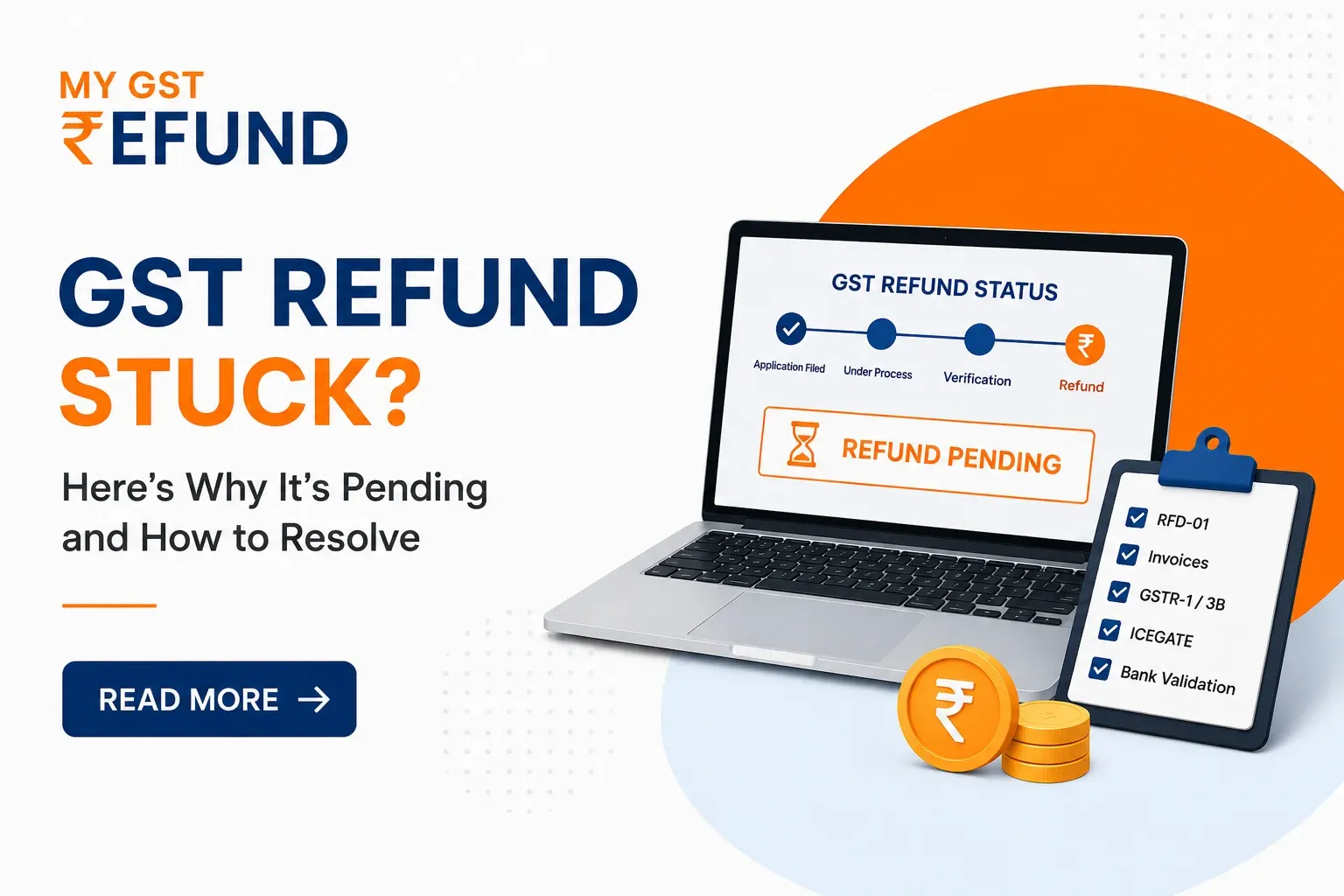
GST Refund Stuck? Here's Why It's Pending and How to Resolve
Is your GST refund stuck for weeks with no update on the portal? You are not alone. There are thousands of businesses and exporters in India who are currently stuck in the situation of having their GST refunds held and don't know what exactly the issue is, or where to escalate it properly.
A stuck refund is far more than a cash flow hassle. This consumes capital, generates anxiety of compliance, and charges you interest that you will never earn back.
This guide explains each and every common GST refund issue, export refund stuck due to procedural mismatch, and guides you through a clear path for the resolution of issues, and when and how to file a formal grievance.
What Counts as a GST Refund Pending Situation?
Not all delays are the same. To resolve the issue, you are required to understand the precise status of your application on the GST portal.
Processing Pending vs Pending for Order vs Deficiency Memo Issued
The 60-Day Statutory Clock and Why It Matters
As per section 54 of the CGST Act, the GST authority has a time limit of 60 days from the date of complete application to process refunds.
If no order is passed within this period, you are entitled to interest at 6% per annum under Section 56, and 9% if the delay is attributable to the department. Track this date from the moment your ARN is generated.
Most Common GST Refund Issues Behind a Stuck Claim
Several technical and procedural errors at the time of filing are the most frequent causes of a GST refund stuck situation. Here is what to check first.
Wrong Refund Category Selected in Form RFD-01
Form RFD-01 has multiple refund categories, excess balance in the electronic cash ledger, ITC on exports under LUT, IGST paid on exports, inverted duty structure, and
more.
Selecting the wrong category routes your claim to the wrong processing path and causes it to stall immediately.
Fix: Verify the category against your actual refund type. If wrong, withdraw the application and refile under the correct category.
Mismatch Between GSTR-1, GSTR-3B, and Shipping Bill Data
This is one of the most common reasons for export refund delays, where exporters face issues. GSTN compares the invoice information of the GSTR-1 with GSTR-3B, and the
data is sent to ICEGATE. Even a minor mismatch stops the process.
Common mismatch points:
- Invoice number formats differ between GSTR-1 and the shipping bill
- IGST value has a rounding difference of even Re 1
- The port code is incorrectly entered in GSTR-1
- Export supply not correctly declared in Table 3.1(b) of GSTR-3B
ITC Blocked Due to Supplier Non-Compliance
If your supplier has not filed their GSTR-1 and GSTR-3B, your ITC claim appears in GSTR-2B as unmatched. Refund officers routinely reject claims where ITC is not reflected in GSTR-2B.
Fix: Follow up with the supplier to file their pending returns. If the supplier is unresponsive, you may need to reverse the ITC claim and pay the tax before re-filing your refund application.Use the CFO Dashboard to track defaulting suppliers
Bank Account Not Validated or PFMS Failure
The refund amount cannot be credited if your bank account on the GST portal is not PFMS (Public Financial Management System) validated.
A mismatch between the bank account on the GST portal and ICEGATE is a separate, frequent cause of export refund delays.
Fix: Go to My Profile on the GST portal, validate your bank account, and allow 3 to 5 working days for PFMS confirmation.
Ineligible ITC Claimed Under Section 17(5)
Section 17(5) blocks ITC on specific items, motor vehicles, food and beverages, personal consumption, works contract for immovable property, and others. If your refund
application includes ITC from these categories, it will be rejected.
Fix: Segregate blocked ITC before filing and ensure only eligible ITC is included in the refund claim.
Export Refund Stuck Due to Procedural Mismatch
GST export refund stuck situations are particularly complex because they involve four separate government systems: GSTN, ICEGATE, PFMS, and the shipping line's EGM filing.
When any one system has incorrect or missing data, the entire chain stalls.
ICEGATE - GSTN Data Sync Failures and Shipping Bill Errors (SB Codes)
Once GSTN transmits data to ICEGATE, the system generates a Status Code (SB Code) for each shipping bill. Understanding these codes is critical to resolving IGST refund pending issues.
Check your SB code under Services > Refunds > Track Refund Status on ICEGATE.
EGM Not Filed or Filed Incorrectly by the Carrier
The Export General Manifest (EGM) is filed by your shipping line after the cargo physically leaves India. Until it is filed and matched against your shipping bill on ICEGATE, no refund is processed, regardless of how accurate your GST returns are.
Fix: To check EGM status, navigate to Services > Enquiry > Public Enquiry 2.0 on ICEGATE. In the case of absence, reach out to your shipping company with the sailing date, shipping bill number, and container number. Escalate in writing if not resolved within 5 working days.
LUT Not Filed or Expired for the Financial Year
Exporting under a Letter of Undertaking (LUT) without a valid, active LUT for that financial year means your export is treated as a taxable supply. This invalidates your ITC refund claim under the LUT route.
Fix: File or renew your LUT on the GST portal under Services > User Services > Furnish Letter of Undertaking. Check that the LUT number cited in your shipping bill
matches the active LUT on the portal.
Invoice Number, Port Code, or IGST Value Mismatches
ICEGATE matches invoice data field by field. A single character difference breaks the automated matching process.
Key fields to verify:
- Invoice number (must be identical in GSTR-1 and shipping bill)
- Port of export code
- IGST amount (check for rounding differences)
- GSTIN of the exporter
GST Refund Situations That Need a Different Fix
Some GST refund situations fall outside the standard export or excess ITC route and need a different resolution approach.
Inverted Duty Structure GST Refund Delays
Businesses where the tax rate on inputs is higher than on outputs can claim refunds on accumulated ITC. These claims are often delayed because:
- Net ITC calculation does not match the formula under Rule 89(5)
- ITC from capital goods is incorrectly included
- Officers require additional GST reconciliation statements
Fix: Prepare a detailed ITC computation as per Rule 89(5), exclude capital goods ITC, and submit a voluntary explanation to your jurisdictional officer.
Need help identifying why your GST refund is pending?
MYGST Refund experts can review your GST refund application, identify mismatches, and guide you through the correction process to get your GST refund.
Schedule a Free GST Refund Consultation Now
Refund Stuck After a Deficiency Memo (RFD-03)
A Deficiency Memo means your application had errors. You have 15 days from the date of the memo to refile a corrected application. If this window is missed, it will be necessary to file fresh.
Fix: In RS-03, respond to all queries before resubmission. Please do not resubmit the same application without addressing the noted concerns.
Refund Withheld Pending Officer Verification or Committee Referral
For large refund amounts, GST officers can refer the claim to a committee or withhold payment pending field verification. This can extend timelines significantly.
Fix: Prepare and submit all supporting documents, invoices, shipping bills, bank realisation certificates, and reconciliation statements before requests. This cuts down back and forth and accelerates reviews.
How to Resolve IGST Refund Pending Issues Step by Step?
1. Track Your Application Status Using the ARN
Log in to the GST portal and navigate to Services > Refunds > Track Application Status. Enter your ARN. Record the status, officer assigned, and the date of last update. After 15 days, if there is no officer, take it up to the jurisdictional GST commissionerate.
2. Check the ICEGATE Shipping Bill Status Separately from the GST Portal
The GST portal does not show ICEGATE-level error codes. Log in to ICEGATE individually, select Services > Refunds > Track Refund Status, and verify the SB Code of the shipping bills in the refund claim.
3. Fix the Mismatch and Decide Whether to Amend or Refile
- SB001 / SB005 errors: Correct the concerned invoice in Table 9A of GSTR-1. The GSTN usually deposits the data into ICEGATE in 48 to 72 hours.
- Category error in RFD-01: Withdraw the application and refile.
- Deficiency memo: Refile the corrected application within 15 days.
4. Validate Your Bank Account and Re-Check PFMS Status
Re-validate your bank account on the GST portal under My Profile > Bank Accounts. Separately verify on ICEGATE. Allow up to 5 working days for PFMS to reflect the updated details.
5. Escalate to the Jurisdictional Officer in Writing
Communicate with the jurisdictional officer if the application is pending for more than 30 days without any action.
Write the required information, including ARN, the amount of the refund, date submitted, and a statement addressing the main issue at hand. Email and follow up by handwritten post.
When to Raise a Formal Grievance Against a GST Refund Stuck?
Using the GST Self-Service Portal/Grievance Redressal
In case officer-level follow-up is not successful, go to the GST Grievance Redressal Portal. Go to the portal, choose the issue type (RFD-01 type), complete the details on the ticket, and enter ARN.
A reference number to trace your complaint will be provided to you.
What to Include in Your Escalation (ARN, Dates, Evidence)
A strong escalation includes:
- Application Reference Number (ARN)
- Date of filing and date the 60 days expires
- SB codes from ICEGATE (for exporters)
- Copies of returns filed, shipping bills, and deficiency memos received
- A timeline of all prior follow-ups
Claiming Interest Under Section 56 for Delayed Refunds
If your refund is delayed beyond 60 days from the date of complete application, you are entitled to interest at 6% per annum.
This is not automatic; you need to explicitly request it in your communication with the officer. Mention Section 56 of the CGST Act and provide the calculated interest amount.
Conclusion
A GST refund stuck scenario is nearly always fixable if you understand the proper places to look. Most of the delay in refunds is due to data mismatch at GSTR-1, GSTR-3B, shipping bills, ICEGATE, etc. or procedural issues such as an unfiled EGM or an expired LUT.
The quickest action is to identify the particular error and correct it at the source, verify your bank account, and escalate it in writing if you are susceptible to the 60-day statutory deadline. Do not wait passively for the portal to update. Track your ARN and SB codes actively, respond to deficiency memos immediately, and claim your Section 56 interest if the delay is the department's fault.
Frequently Asked Questions (FAQs)
1. How long do GST refunds take?
For clean applications with no errors, refunds are typically processed within 15 to 30 days of filing. The statutory maximum is 60 days from the date of a complete application under Section 54 of the CGST Act.
2. Why are GST refunds delayed this year?
In 2026, the most common causes are ICEGATE-GSTN data sync failures, supplier non-compliance affecting ITC claims, PFMS bank validation failures, and increased manual scrutiny on large refund amounts.
3. Why haven't I received my GST refund?
Check your ARN status on the GST portal and your SB code on ICEGATE separately. Common blockers include a deficiency memo you may have missed, an unvalidated bank account, or an EGM not filed by your shipping line.
4. What if it's been 21 days and still no refund?
After 21 days, check to see if an officer's been assigned and if any queries are pending. If no action has been taken, write to the jurisdictional officer with your ARN details. You are not yet entitled to interest at this stage, which kicks in after 60 days.
5. Is a GST refund within 7 days possible?
A 7-day refund is generally not possible through the standard RFD-01 route. However, provisional refunds of 90% of the claim amount can be granted within 7 days for exporters of goods under Rule 91 of the CGST Rules, pending final verification
Related Posts