HSN Codes Finder Online: A Guide
Published on: Sat Jul 18 2026
Adv. Hetal Bansal

Bio (Reveal/Hide)
HSN Codes Finder Online: A Guide
Every GST invoice needs one thing right, the HSN code. Get it wrong, and your GST return is “flagged”, input tax credit is delayed, or the buyer refuses the invoice. Many businesses still search for HSN codes manually, guess the applicable classification, or simply copy codes used by competitors without verifying whether they apply to their products.
This is where an HSN finder can be extremely helpful because it will easily match your product description to the correct code rate and GST rate in one search. In this guide, you'll learn what HSN codes are, why they're important, and how to ensure you always have the right code.
What is an HSN Code and Why It Was Introduced?
HSN means Harmonised System of Nomenclature. An internationally structured system of classification of products, which was developed by the World Customs Organisation in 1988 and is used by more than 200 countries.
Before HSN, every country classified goods differently. A textile exporter shipping to Germany and the United States had to deal with two different classification languages for the same product.
HSN fixed this by creating one numeric code for each product category. Customs officers, tax departments, and trade bodies across the world now read the same code the same way. India adopted HSN under GST to bring uniformity to how goods are taxed and reported.
It is expressed in six digits as an International base code, expanded to eight digits in India for Indian classification. Each digit makes the product more specific, as it moves from a general product towards a product in detail.
Importance of HSN Code Under GST
HSN codes are not optional labels. They determine what GST slab your product falls under, how the validation of your GSTR-1 return is carried out, and whether you are able to get your invoice accepted at the time of the e-invoice checking process.
- If the HSN code is wrong, it could lead to incorrect tax rates being applied, thereby undercharging or overcharging the buyer, either of which would raise them up for questioning.
- Under the rules of the GST, businesses with gross receipts of more than 5 crore rupees are required to mention the six-digit HSN code, and for exports and imports, all 8 digits are compulsory.
- Incorrect or missing HSN codes may lead to GST notices, invoice rejection, delayed refunds, disputes during audits, and penalties under applicable GST provisions
Benefits of Using an HSN Code Finder for Your Business
A dedicated HSN finder tool does more than return a code. It gives context that a plain list cannot.
- Confirms the exact 8-digit code instead of a partial or outdated one
- Shows the applicable GST rate alongside the code
- Reduces classification disputes during GST audits
- Helps new team members bill correctly without training on tariff charts
- Saves time compared to searching through CBIC's tariff schedule manually
How HSN Finder India Tools Save Time on Invoicing?
For a business raising hundreds of invoices a month, looking up each product manually in a tariff book is not practical.
An HSN finder India tool allows the billing staff to type the name of the product and retrieve it within seconds, instead of having to open a PDF-based tariff schedule and/or call the accountant to give out the code for a new product added to the catalogue every time.
This can be a great advantage for companies that have a large variety of products, like manufacturers, distributors, and retailers that are continually adding new SKUs.
Structure of the HSN Code List: Reading 4, 6, and 8 Digits
The HSN code list is not random. It follows a fixed hierarchy where every pair of digits narrows the classification.
8 Digit HSN Code List for Imports and Exports
For import and export transactions, all 8 digits are mandatory regardless of turnover. This is because customs authorities need the most precise classification to apply the correct customs duty and to match the shipping bill with the GST invoice.
- If an exporter is exporting textile items, then they won't be able to mention a generic 4-digit code on the shipping bill.
- If the shipping bill serial number on the shipping bill is different from that in the invoice and GSTR-1 filing, then the refund is stuck in clarification status.
GST HSN Code List: Sections, Chapters, and Headings Explained
There are 21 sections and 99 chapters in the list of GST HSN codes, which include products ranging from live animals to works of art. Related product categories are contained within each chapter, with subheadings and headings creating a subcategory in every chapter.
Understanding this structure helps when a product does not have an obvious match. Instead of searching randomly, you can narrow down the chapter first, based on the broad material or purpose of the product, and then move to the specific heading.
HSN Code vs SAC Code: Which One Applies to Goods and Services
This is one of the most common points of confusion for businesses that deal in both products and services.
HSN code is required if your business deals in physical goods. If you are a digital service provider, like a consultant, software developer, or digital marketer, you'll need a SAC code.
Businesses that do both, such as a company selling hardware and offering installation services, need to use HSN for the goods and SAC for the service component separately on the same invoice.
How to Find HSN Code for Your Product or Service?
Searching through a printed tariff schedule isn't necessary to find the right code. There are three possible practical approaches based on the amount of detail one already has.
Search by Product Name
The most effective way to find an HSN code by product name is to submit a basic description for an item, such as stainless steel utensils or a cotton t-shirt, to an HSN finder tool. The tool matches your description against the tariff database and returns the closest code along with its GST rate.
This method works well for common products, but should be double-checked against the tariff description if your product has a specific material composition or use case that changes its classification.
Find HSN Code Using GST Portal Search
The HSN code finder GST portal is the government's own search tool, available under Services, User Services, Search HSN Code, on the official GST website. It does not require a login and allows you to search by code or description.
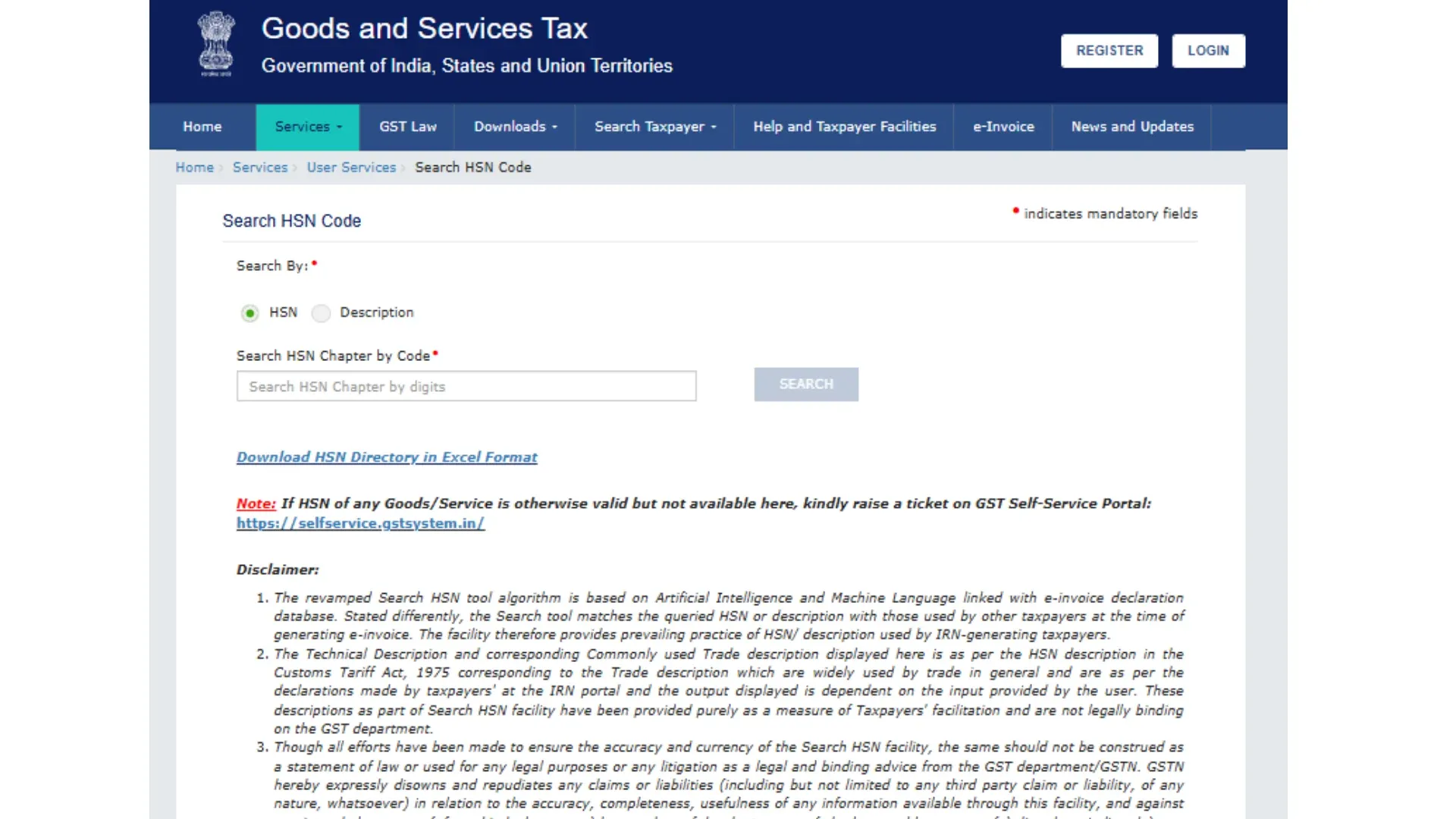
When you need to double-check a code before submitting, the safest method is to use the HSN code finder on the government website, as it will access the official code list, while a third-party list may not be updated.
Common Mistakes to Avoid While Finding or Using HSN Codes
Many GST notices trace back to avoidable errors in HSN classification rather than actual tax evasion.
- Using a competitor's HSN code without checking if the product composition matches
- Applying a 4-digit code where 6 or 8 digits are mandatory based on turnover
- Mixing up HSN and SAC codes for combined goods and service invoices
- Not updating the code when the product specification or packaging changes
- Ignoring the GST rate changes announced by the CBIC after a council meeting
- Leaving the HSN field blank on export invoices, which blocks refund claims
MYGSTRefund's HSN Finder
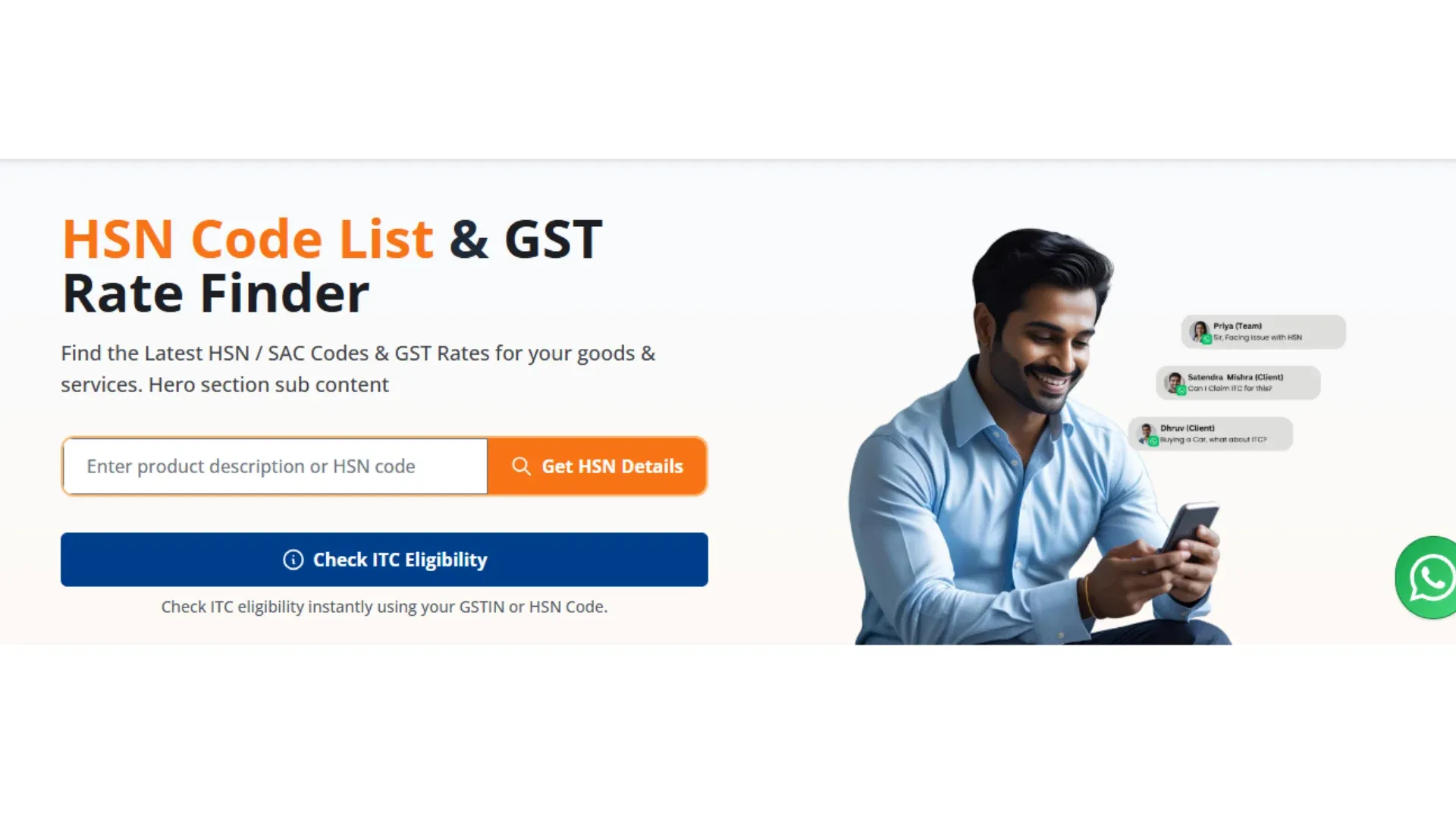
MYGSTRefund HSN and SAC Finder allows users to search for products by name or code and instantly display the matching 8-digit HSN Code, applicable SAC Code, and GST Rate on a single page. It uses the same CBIC tariff structure as mentioned on the official GST portal, making it filing-ready.
It saves you the time of manually checking each product on a static PDF list and helps ensure consistency of your GSTR-1s with your invoicing system if you use bulk product catalogues.
Conclusion
Getting the HSN code right is not a small compliance detail; it directly affects your tax rate, your GSTR-1 accuracy, and your refund timelines. When selecting a product code and rate, an HSN finder saves time by finding the match in real time.
Frequently Asked Questions(FAQ’s)
1. Does the HSN code change if a product is sold in different states within India?
No, HSN codes are uniform across India since they follow a national tariff structure. The code and its GST rate remain the same regardless of the state where the product is sold.
2. What happens if two different HSN codes both seem to fit a product?
Determine the classification code that is most closely applicable to the primary function and material of the product, and have supporting documents on hand to respond to questions of classification.
3. Is there a way to appeal or request clarification if I disagree with an HSN classification?
Yes, the businesses can seek an Advance Ruling from the GST AAR in their state to get an official classification decision.
4. Do service exporters need an HSN code, or only a SAC code?
Only the service exporter has to have a SAC code, as HSN codes are relevant for physical goods only, and the SAC code is applicable to all kinds of services.
5. How often does the government revise or add new HSN codes, and how do I stay updated?
HSN codes and respective rates are updated by the CBIC from time to time via notifications, typically after a meeting of the council on the GST. Therefore, it is essential to follow the CBIC as well as the GST portal notifications frequently.
Related Posts