
Reverse Charge vs Forward Charge in GST: Complete Guide
Published on: Wed Oct 07 2026
Adv. Hetal Bansal

Bio (Reveal/Hide)
Reverse Charge vs Forward Charge in GST: Complete Guide
Who actually pays the GST on a purchase you or your supplier? Reverse GST vs. forward GST is the question behind that, and a wrong answer shows up as a tax demand with 18% interest. Most merchants assume the seller always collects GST. That is true only for forward charge. For a notified list of purchases, the law makes you the taxpayer.
This is a problem of habit. Nearly all invoices are subject to GST, and you never get to know where the exceptions are! This guide deals with both mechanisms, the legal basis, the 2026 RCM list, Input Tax Credit (ITC), cash-flow impact, and some of the more common errors that we come across when analysing actual GST returns.
Who Pays GST, Buyer or Seller?
Start with the big picture, then we will go deeper.
What Is Forward Charge (FCM) in GST?
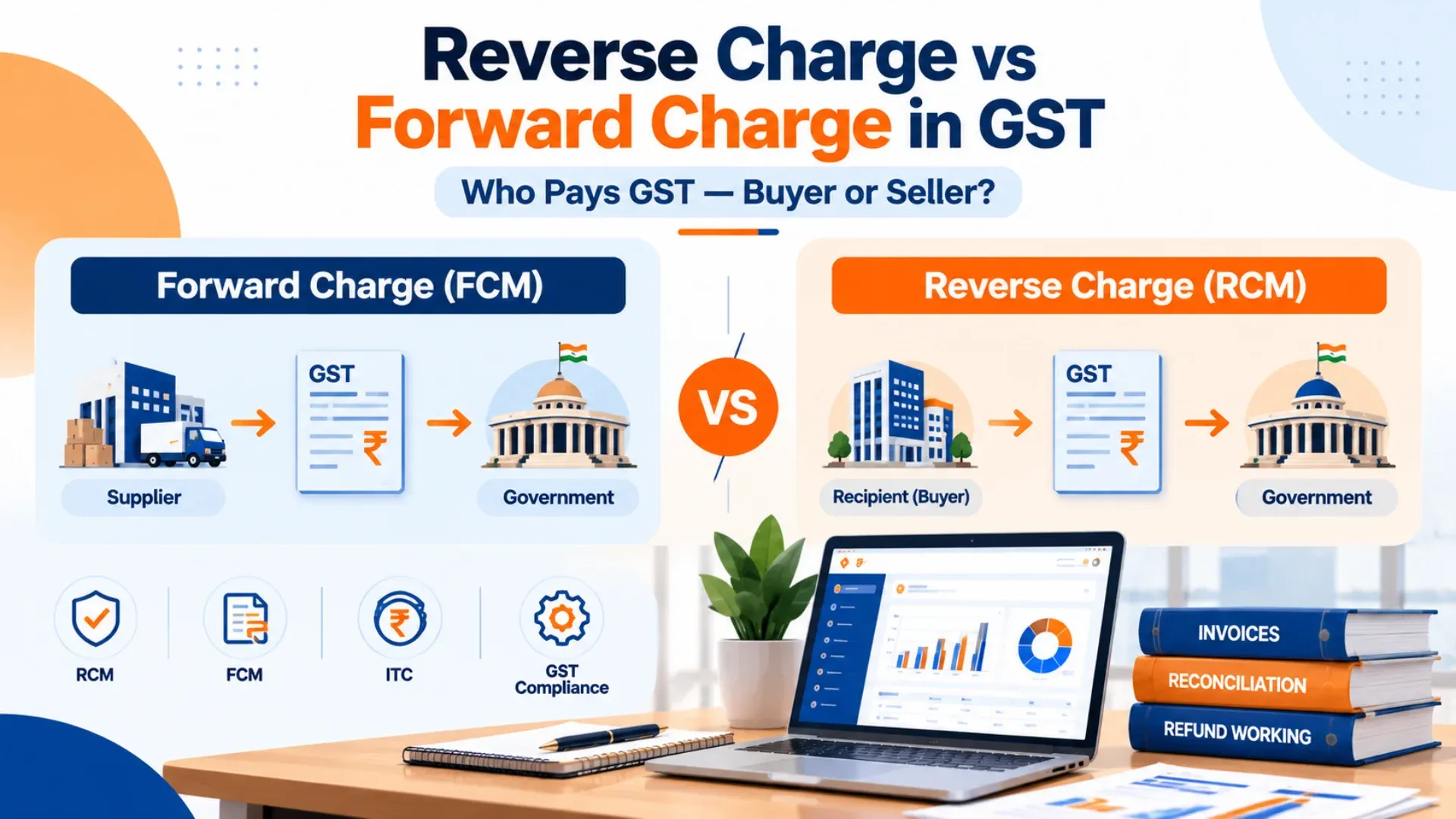
Forward charge is the default. Forward charge is the default. The supplier includes GST on the invoice and then pays the amount to the government, while the buyer pays the supplier.
- The tax flows forward along the supply chain.
- The supplier pays output tax using ITC first, then cash.
- The buyer claims ITC if eligible.
Forward charge mechanism example: If a merchant sells a handset for ₹10,000 plus 18% GST, the customer pays ₹11,800 to the merchant. The merchant reports an output GST liability of ₹1,800 and may utilise eligible ITC against the liability, with the balance, if any, paid in cash.
What Is Reverse Charge (RCM) in GST?
The liability is shifted under reverse charge. The supplier is no longer liable for collecting tax, but the recipient is to do so themselves.
Why it is present: RCM shifts the tax liability to the recipient for specified categories of supplies notified under GST law, including certain supplies where collection of tax from the supplier is not considered appropriate or practical.
Legal basis:
- Section 9(3), CGST: Notified goods and services, in any supplier-recipient combination specified.
- Section 9(4), CGST: Supplies of specified categories of goods or services by an unregistered supplier to a specified class of registered persons, as notified by the Government
- Section 5(3)/(4), IGST: Import of services and notified inter-state supplies.
- Section 24(iii): Persons liable to pay tax under RCM must generally register, subject to notified exemptions. Persons required to pay tax under RCM may be required to obtain GST registration, subject to the applicable provisions and notified exemptions.
A myth to drop: Many blogs say you pay RCM on every purchase from an unregistered vendor. That is wrong.
Stationery or a freelancer's design work from an unregistered person is not under RCM, because it is not notified.
GST Reverse Charge List: Common Entries Merchants Meet
The RCM list lives in Notification 4/2017-CT(Rate) for goods and 13/2017-CT(Rate) for services, both as amended.
*GTA rule: the notification specifies recipients such as registered persons, factories, companies and societies. Certain GTA supplies may be taxable under forward charge where the GTA satisfies the applicable conditions and exercises the prescribed option. The applicability of RCM should therefore be determined based on the nature of the supply, supplier, and recipient.
If a landlord is registered, the rent is normal forward charge. The test is always the supplier-recipient pair the notification names.
Reverse Charge vs Forward Charge in GST: Key Differences
Here is the detailed comparison. It answers "difference between RCM and FCM in GST with an example.
Reverse GST Calculation vs Reverse Charge: Two Different Concepts
Many merchants searching for a "reverse GST calculator" want something else entirely. They want to extract GST from a GST-inclusive price. That is a calculation method, not RCM.
Reverse calculation (GST-inclusive price):
- Base value = Gross × 100 ÷ (100 + GST rate)
- GST = Gross − Base value
- Example: ₹11,800 at 18% gives a base of ₹10,000 and GST of ₹1,800.
Reverse charge calculation (RCM):
An unregistered landlord lets commercial immovable property to a registered person for ₹50,000 per month, and the transaction falls under RCM.
- RCM = ₹50,000 × 18% = ₹9,000, paid from the cash ledger.
- In case of use of premises for taxable supplies, the merchant is entitled to ₹9,000 as ITC in the same return.
Calculators for both tasks are in the next section's workflow, which shows what happens after the number is known.
How RCM Works Step by Step
Let's walk through the actual workflow, since this is where filing errors start.
- Identify the inward supply against the notified list.
- Fix the time of supply. This is the earliest of the dates in the table below.
- Issue a self-invoice where required under Section 31(3)(f), particularly in cases involving supplies from an unregistered supplier covered by RCM.
- Issue a payment voucher when you pay the supplier (Section 31(3)(g)).
Pay tax in cash through the electronic cash ledger. - Report in GSTR-3B Table 3.1(d).
- Subject to eligibility and applicable reporting requirements, claim the corresponding ITC in the appropriate section of GSTR-3B, including Table 4(A)(3) for inward supplies liable to RCM and the applicable row for import of services
In GSTR-9, RCM inward supplies appear in Table 4G.
ITC and Cash Flow: What Reverse Charge Does to Your Money?
Now the question merchants ask most: can I use ITC to pay reverse charge liability? GST payable under RCM cannot generally be discharged using the electronic credit ledger and is required to be paid through the electronic cash ledger. Eligible ITC may subsequently be claimed after the applicable conditions are satisfied
Why it hurts cash flow: You pay first, then the ITC lands in your credit ledger. That ITC can only be used against future output tax. A merchant with a large ITC balance still has to pay RCM in cash.
Conditions for ITC on RCM:
- Tax must actually be paid.
- Section 16 conditions apply, including the time limit from the invoice or debit-note date.
- Section 17(5) blocks (for example, certain motor vehicle or personal-use items) apply to RCM credit too.
Reverse GST vs Forward GST for Small Business and E-Commerce Sellers
Compliance gets trickier when your business model is not a simple shop.
- Composition dealers: must pay RCM in cash and cannot claim ITC. They also cannot make inter-state outward supplies, so any example showing one is flawed.
- Small businesses below threshold: RCM liability may have implications for GST registration depending on the applicable registration provisions and exemptions.
- E-commerce sellers: Section 9(5) provides for the electronic commerce operator to discharge GST on specified categories of services notified by the Government. This
mechanism is distinct from the recipient-based RCM provisions. - Exporters and importers: import of services is RCM under Section 5(3). In the present case, Union of India v. Mohit Minerals (2022), in Union of India v. Mohit Minerals Pvt. Ltd., the Supreme Court held that IGST could not be levied on ocean freight paid in a CIF import transaction under the reverse charge mechanism in the circumstances considered by the Court.
Common RCM Mistakes and How to Fix Them
Mistake 1: Paying RCM through the credit ledger.
- Why it happens: Teams treat it like output tax.
- Fix: Pay via cash ledger. Reverse the wrong utilisation with interest.
Mistake 2: Claiming ITC before payment.
- Fix: Claim ITC only in the period the tax is paid.
- Mistake 3: Treating all unregistered purchases as RCM.
- Fix: Match each purchase to the notified entry before computing.
Mistake 4: Missing rent RCM.
- Real scenario: A merchant who pays ₹60,000/month to a small landlord sees the shortfall during an audit; an 18% interest is charged on the remaining of his monthly
liability, ₹10,800. - Fix: You should add RCM tagging to your ledger master.
Mistake 5: No self-invoice.
- Fix: Issue self-invoices and payment vouchers at the appropriate time.
What if the merchant does not receive RCM payment? Delay or non-payment of RCM liability may result in interest under Section 50 and, depending on the facts and applicable provisions, may also attract penalty or other consequences under the GST law.
Latest Updates (2026)
Before finalizing monthly working, please make sure to check these:
- Commercial property rent: Unregistered landlord to registered tenant has been RCM since 10 Oct 2024.
- Metal scrap: RCM from 10 Oct 2024 (with 2% TDS on specific B2B supplies).
- Sponsorship: The GST treatment of sponsorship services should be determined based on the applicable notification, nature of recipient and supplier, and the relevant RCM provisions
- GST rates and RCM applicability may change through amendments and notifications. Businesses should verify the applicable rate and RCM treatment for the relevant period before finalising their working
- Discipline return: GSTR-3B cannot generally be revised once filed. Errors identified in RCM reporting may therefore need to be appropriately adjusted in a subsequent return, subject to the applicable provisions and time limits.
The RCM list is updated based on amendments. Always confirm with CBIC notifications before using a fixed list.
Conclusion
A forward charge is initiated on an invoice. Reverse charge is based on your own responsibility. Identify applicable RCM supplies, determine the time of supply, complete the required documentation, discharge the tax liability within the applicable timelines, and claim eligible ITC after satisfying the prescribed conditions.
That discipline ensures that notices on interest and demand remain off your books.
MYGST Refund Platform can help businesses analyse GST return data, identify potential RCM and ITC reconciliation gaps, and streamline GST compliance and refund workflows.
Frequently Asked Questions(FAQ's)
1. What is the difference between FCM and RCM?
In FCM, the supplier pays GST. In RCM, the recipient pays it directly, in cash, on notified supplies.
2. Is RCM mandatory for all merchants?
It is mandatory for any registered merchant who buys a notified supply. It is not optional.
3. Can I use ITC to pay reverse charge liability?
No. Use the electronic cash ledger, then claim ITC afterwards.
4. When does a merchant pay reverse charge GST?
When a notified supply is received, generally per the time of supply rules above.
5. How to claim ITC on reverse charge GST?
Pay the tax, report it in Table 3.1(d), then claim it in Table 4(A)(3) or 4(A)(2).
6. What if the supplier wrongly charges GST on an RCM supply?
Reconcile before claiming ITC. Credit risk and possible double payment arise, so get the invoice corrected.
Related Posts