Latest GST Case Laws May 2026
Published on: Fri Jun 05 2026
Adv. Hetal Bansal

Bio (Reveal/Hide)
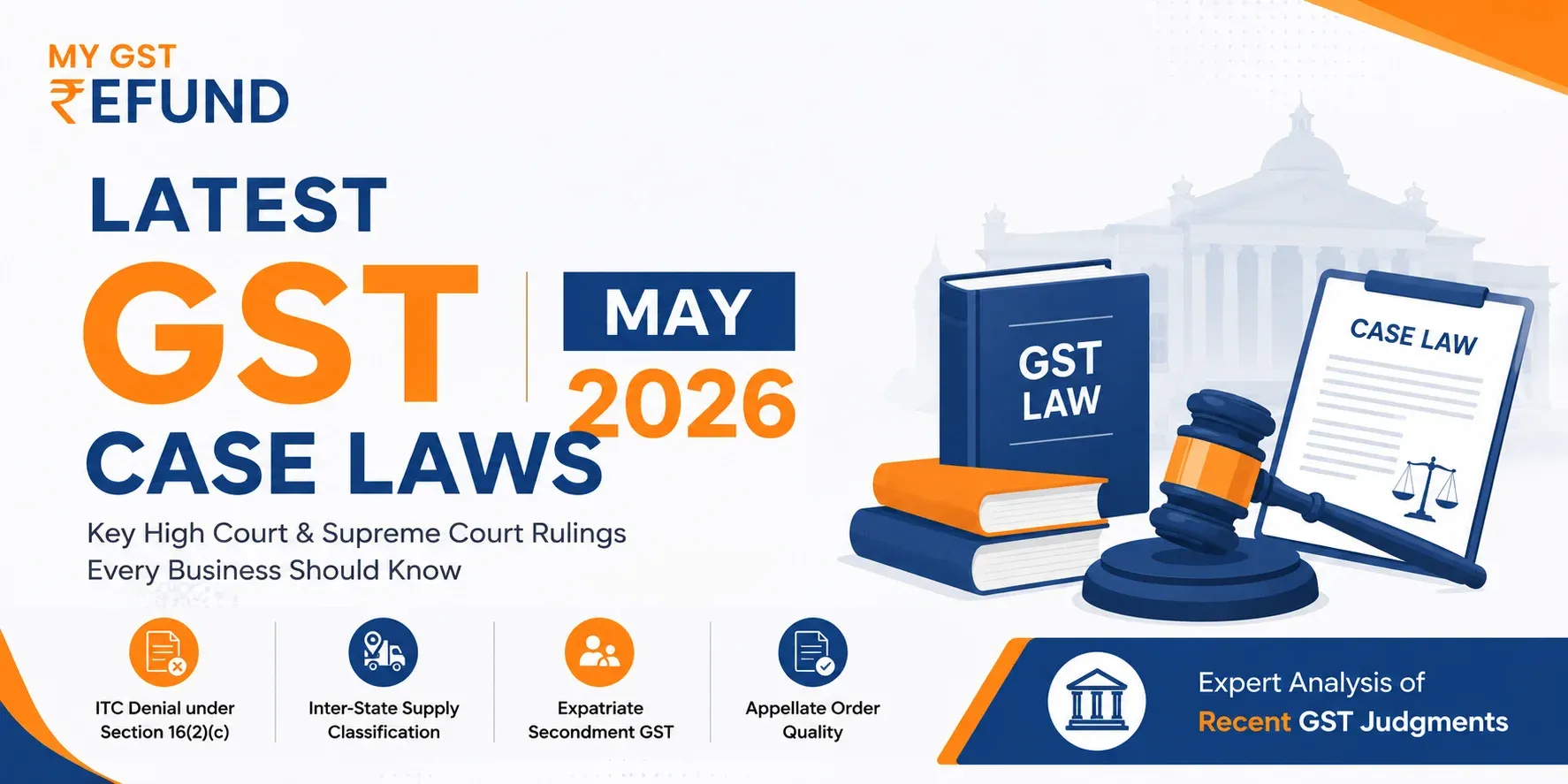
Latest GST Case Laws May 2026: Important Judgments for Businesses and CAs
If you missed the latest GST case laws in May 2026, you may already be risking your business. Indian courts delivered a number of important rulings this month on ITC denial, taxation of expatriate secondment, quality of appellate order, and classification of inter-State supply. These rulings directly impact the way businesses handle ITC claims, vendor compliance, and GST disputes.
These May 2026 rulings are crucial for small traders in Gujarat and large organisations engaged in cross-border employee deployments to stay compliant and protect their tax positions.
Overview of GST Case Laws Issued in May 2026
The judgements of May 2026 came from the Gujarat High Court, Supreme Court, Punjab and Haryana High Court, Rajasthan High Court, and Bombay High Court. The orders dealt with a variety of GST issues.
Courts That Delivered Key GST Rulings in May 2026
GST Case Law on ITC Denial - Gujarat High Court
This ruling is among the most impactful GST case laws for Indian businesses this month. It directly affects every buyer who claims ITC based on invoices from suppliers who have not deposited tax.
Maruti Enterprise vs Union of India - 01 May 2026
- Court: Gujarat High Court
- Appeal No: R/Special Civil Application No. 18080 of 2023
- Judges: Justice A.S. Supehia and Justice Pranav Trivedi
- Decided in favour of: Revenue
Facts of the Case
- Registered dealers had purchased goods and services from registered suppliers and claimed ITC based on tax invoices reflected in GSTR-2A and GSTR-2B. But the suppliers did not deposit the tax collected by not filing GSTR-3B or defaulting in payment.
- The buyers had challenged the constitutional validity of Section 16(2)(c) of the CGST Act, on the ground that the denial of ITC in case of default by the supplier was arbitrary.
What the Court Held
- The High Court of Gujarat held that the ITC is not a vested or a constitutional right but a statutory concession and is subject to fulfilment of the conditions prescribed, and upheld the constitutional validity of Section 16(2)(c).
- The Court also observed that Section 41(2) and Rule 37A adequately protect the purchasers, as the recipient can again take the reversed ITC once the supplier deposits the tax.
Impact on Business
- Buyers cannot claim ITC unless their supplier has actually deposited tax with the government.
- Verify vendor GSTR-3B filing status every month before claiming ITC
- Track supplier compliance using GSTR-2B and follow up proactively
GST Case Law on Inter-State Supply - Supreme Court
This Supreme Court ruling is significant for businesses dealing in cross-State sales and has strong relevance for interpreting supply classification under GST.
State of Uttar Pradesh vs Reliance Industries Ltd. - 16 May 2026
- Court: Supreme Court of India
- Civil Appeal No: 3910 of 2016
- Decided in favour of: Taxpayer
Facts and Ruling
- The Supreme Court held that the sale of natural gas by Reliance Industries from the KG Basin in Andhra Pradesh to buyers in Uttar Pradesh was an inter-State sale and could
not be subjected to VAT under the UPVAT Act and upheld the Allahabad High Court’s ruling to that effect. - The decision stresses that the nature of supply and the movement of goods in the course of a sale transaction are what primarily determine the nature of supply and that States cannot impose local tax where the transaction is inter-State in the terms of the constitutional and statutory scheme.
Business Impact
- Confirms that the actual movement of goods determines inter-State supply classification
- Relevant for businesses challenging double taxation by State authorities
- Strengthens the taxpayer's position in State-level GST and VAT disputes
GST Case Law on Appellate Order Quality - Rajasthan High Court
This ruling is a strong signal to tax authorities about the standard of adjudication expected under the GST law.
Ircon PB Tollway Ltd. vs Union of India - 16 May 2026
- Court: Rajasthan High Court
- Writ Petition No: D.B. Civil Writ Petition No. 9602/2026
- Decided in favour of: Taxpayer (interim relief granted)
Facts and Ruling
- The Rajasthan High Court heavily criticised the first appellate authority for disposing of the assessee’s GST appeal by allegedly copying the Order-in-Original almost
word for word, without any independent reasoning or judicial application of mind. - The High Court directed the impleading of the concerned appellate officer as a party, ordered the filing of a personal affidavit, and stayed the operation of both the original and appellate orders till further hearing.
Business Impact
- Businesses can challenge appellate orders that are copy-paste reproductions of the original order.
- Courts are closely scrutinising the quality of GST adjudication
- If your GST appeal has been dismissed without independent reasoning, this ruling supports filing a writ petition
GST Case Law on Expatriate Secondment - Punjab and Haryana High Court
Secondment of foreign employees is a longstanding grey area in GST. This May 2026 ruling provides important guidance.
Yamazen Machinery vs Union of India - 16 May 2026
- Court: Punjab and Haryana High Court
- Writ Petition No: CWP-7448-2024
- Decided in favour of: Taxpayer (remanded for fresh decision)
Facts and Ruling
- The dispute was whether deploying expatriate employees by an overseas group entity amounts to the import of manpower supply services taxable under reverse charge.
- The Punjab and Haryana High Court agreed with the requirement of review and directed the adjudicating authority to reconsider the applicability of the CBIC Instruction
No. 05/2023-GST, Circular No. 210/4/2024-GST, and relevant judicial precedents, and thereafter pass a reasoned order after proper factual analysis. - The court pointed out that the Northern Operating Systems decision cannot be applied generally to all secondment arrangements because the legal position depends on the
actual contractual terms, control over employees, salary arrangements, and the true nature of the employment relationship.
Business Impact
- All companies with foreign parent entities deploying employees in India must review their secondment contracts
- Reverse charge liability depends on facts specific to each arrangement
- Obtain a proper legal opinion before reversing ITC or paying reverse charge on secondment costs
Quick Reference: Key May 2026 GST Case Laws Summary
How to Dispute a GST Ruling Based on May 2026 Case Law Precedents
If you have received an adverse GST order, these May 2026 rulings offer useful precedents.
- For ITC denial due to supplier default: cite Rule 37A and argue for re-availment once the supplier deposits tax
- Appellate orders to file: file writ petition referring to Rajasthan HC ruling. Seek the liability of the appellate authority.
- In case of disputes relating to secondment, rely on CBIC Circular No. 210/4/2024-GST and P and H HC ruling to argue for case-to-case analysis.
- For inter-State supply classification: cite the Supreme Court ruling in Reliance Industries to resist State-level tax imposition
Conclusion
The release of GST case laws in May 2026 is a strong reminder to Indian businesses that ITC is a conditional right, appellate authorities are required to exercise independent judgement and secondment arrangements must be carefully structured. The Gujarat HC ruling on Section 16(2)(c) alone has significant cash flow implications for any business relying on vendor-based ITC.
Frequently Asked Questions
1. What are the top GST legal rulings from May 2026 affecting Indian businesses?
Here are the four impactful rulings: Gujarat HC upholding denial of ITC under Section 16(2)(c); Supreme Court upholding classification of inter-State supply for Reliance; Rajasthan HC staying copy-paste appellate order; and Punjab & Haryana HC remanding expatriate secondment dispute for fresh adjudication.
2. How did recent GST case laws in May 2026 impact service providers?
Service providers with expatriate employees must review secondment arrangements after the Yamazen ruling. Service companies also face stricter ITC scrutiny following the Gujarat HC ruling, which requires confirmation that all vendors have actually deposited GST before ITC is claimed.
3. How to dispute a GST ruling based on May 2026 case law precedents?
Appeal to the first appellate authority within a period of three months from the date of the demand order. If the appellate order has no independent reasoning, file a High Court writ citing the Rajasthan HC ruling. You can cite precedents in your submissions from CBIC circulars and relevant High Court judgments.
4. What are the financial implications for small businesses based on the May 2026 GST case laws?
Gujarat HC ruling on ITC denial is the biggest for small businesses. If the vendor does not file GSTR-3B, then the buyer will have to reverse the ITC and pay it back with interest @18 per cent per annum till the time the supplier deposits the tax. Vendor compliance monitoring has become a financial imperative.
Related Posts